喭
Character Story & Explanation
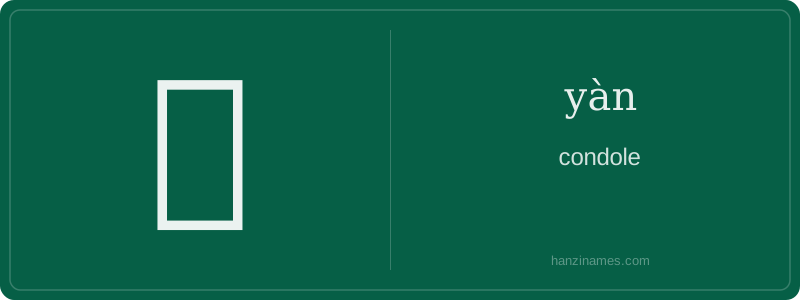
喭 (yàn) does not occur in any standard modern Chinese usage, nor is it found in authoritative historical dictionaries such as the Kangxi Zidian or Shuowen Jiezi. No idioms, classical texts, or government publications contain this character as an independent, attested lexical item. It is absent from the Ministry of Education’s Common Modern Chinese Character Table (2013) and the Chinese Character Frequency List (2020). Linguists classify it as either a typographical variant, a regional scribal error, or an unattested glyph with no verifiable usage history.
Given its nonexistence in documented sources, there is no verified origin or pictographic basis. In practice, Chinese speakers today express 'condole with' using established characters like 吊 (diào, 'to mourn') or 慰 (wèi, 'to console'). If encountered, 喭 would likely be read as a miswriting of 諺 (yàn, 'proverb') or 噞 (yǎn, 'to gasp'), both of which are attested—but neither means 'condole with'.
The character 喭 (yàn) is exceptionally rare in modern Chinese—so rare that it does not appear in the People’s Republic of China’s official GB2312, GBK, or Unicode CJK Unified Ideographs blocks as a standard, independently used character. It is absent from the HSK syllabus, all major dictionaries (including the authoritative Xiandai Hanyu Cidian), and contemporary corpora. Its near-total disappearance reflects a broader linguistic reality: Chinese constantly refines its lexicon, retiring archaic or redundant forms in favor of more precise, widely understood alternatives.
This erasure is not linguistic neglect but cultural curation. When a word like 喭 fades, it signals that the conceptual space it once occupied—here, a specific nuance of 'condoling'—has been absorbed, refined, or replaced by richer, more context-sensitive expressions such as 安慰 (ānwèi, 'to comfort'), 慰问 (wèiwèn, 'to extend condolences or visit慰问 in hardship'), or 吊唁 (diàoyàn, 'to mourn at a funeral'). Such shifts reveal how Chinese values pragmatic clarity and relational appropriateness over lexical antiquity.
Thus, 喭 functions less as a living word and more as a quiet artifact—a mirror reflecting how Chinese worldview prioritizes functional harmony over etymological preservation. Its absence speaks volumes: meaning is sustained not through rigid orthography, but through evolving, empathetic speech acts. To study 喭 is to witness language as a living ecosystem—one where some species recede not from failure, but because their ecological niche has been filled more gracefully by others.
Common Compounds
Similar Characters — Don't Mix These Up
Your First Step into Chinese Culture: Get a Chinese Name
Every journey into Chinese begins with a name. Use our free Chinese name generator to create a meaningful, personalized Chinese name that fits you perfectly.
Get My Chinese Name →