哟
Character Story & Explanation
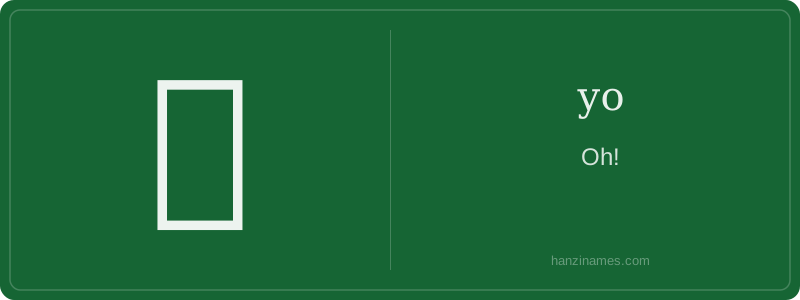
哟 is a quintessential spoken interjection in modern Mandarin, widely used in northern dialects and standard Putonghua for softening statements, expressing mild surprise, or adding rhythmic warmth — especially in songs, nursery rhymes, and maternal speech. It appears in documented folk lyrics (e.g., Beijing ‘xiǎo tiáo’ children’s chants) and mid-20th-century radio dramas as a marker of亲切 (qīnqiè, ‘closeness’). No classical idiom contains it; it’s absent from the Kangxi Dictionary (1716), confirming its late vernacular origin.
Its written form is not pictographic — it has no oracle-bone or bronze-script ancestor. Instead, it’s a phonosemantic compound created during the Ming–Qing transition: 口 signals oral use, and 由 (yóu) provides phonetic approximation. In daily life, mothers say ‘走哟!’ (Zǒu yo! — 'Let’s go!') to toddlers; teachers chant ‘对哟!’ (Duì yo! — 'That’s right!') to affirm students — always with rising pitch and smile.
As a linguistic detective, I begin with the radical: 口 (kǒu), meaning 'mouth' — an unmistakable clue that 哟 is vocal, not visual. This character belongs to the category of interjections — sounds emitted spontaneously from the mouth, not describing objects or actions. Its nine strokes form a compact, balanced structure: the left 口 anchors it phonetically and semantically, while the right component, 由 (yóu), serves primarily as a phonetic cue, hinting at pronunciation rather than meaning.
Historically, 哟 emerged in late imperial and early modern Chinese vernacular texts — not in classical inscriptions or oracle bones, which lack this colloquial exclamation. It gained prominence in 20th-century spoken-language literature, opera scripts, and folk songs, where tone and emotional nuance mattered more than grammatical precision. Unlike characters with ancient pictographic roots, 哟 is a phonogram: engineered for sound, not symbolism — a deliberate fusion of mouth + phonetic.
The tone is critical: it’s pronounced yō (first tone, high-level), never yó, yǒ, or yò. Though often romanized as 'yo', this masks its tonal precision — a subtle but essential marker of sincerity or playfulness. Misplacing the tone turns it into nonsense or another word entirely. Its brevity (9 strokes) belies its expressive weight: one syllable can convey surprise, gentle teasing, affectionate prompting, or light admonishment — all depending on context, speaker intent, and intonation.
Example Sentences
Common Compounds
Similar Characters — Don't Mix These Up
Your First Step into Chinese Culture: Get a Chinese Name
Every journey into Chinese begins with a name. Use our free Chinese name generator to create a meaningful, personalized Chinese name that fits you perfectly.
Get My Chinese Name →