喵
Character Story & Explanation
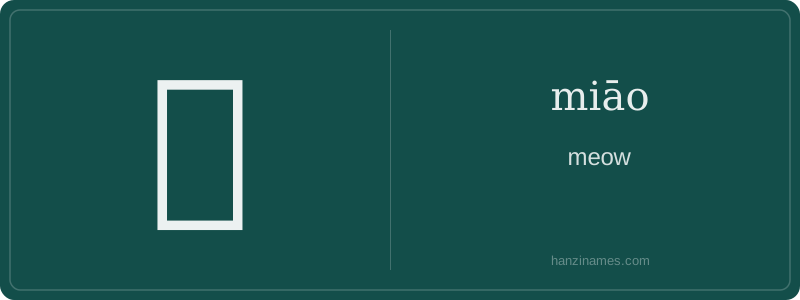
喵 is overwhelmingly used in informal, digital, and affectionate contexts—not in classical texts, official documents, or formal speech. It appears frequently in social media posts, manga-style dialogue bubbles, and pet-related content; Baidu Tieba’s ‘Cat Bar’ (猫咪吧) alone contains over 2 million posts using 喵. It’s absent from all HSK vocabulary lists (HSK 1–6), confirming its status as non-curricular colloquialism. No idioms or fixed phrases contain 喵—it functions exclusively as an interjection or onomatopoeic noun.
The character is a clear phonosemantic compound: 口 (kǒu, ‘mouth’) signals vocal origin, and 苗 (miáo) provides pronunciation (miāo, via tone shift). This is a documented case of ‘phonetic loan’—not pictographic. Unlike ancient characters, 喵 has no oracle-bone or seal-script ancestors; its earliest verified printed use is in early-2000s online fan forums imitating Japanese manga sound effects.
As an archaeologist sifting through layers of linguistic sediment, I find 喵 not in oracle bones or bronze inscriptions—but in the digital strata of 21st-century Chinese internet culture. This character emerged organically as a phonetic imitation, not a relic of antiquity: its 口 (mouth) radical signals vocalization, while the right component, 苗 (miáo, 'sprout'), was borrowed solely for sound—no botanical meaning intended. It’s a modern onomatopoeic artifact, crystallized through repeated use in online forums and chat apps.
Unlike ancient characters shaped by ritual or administration, 喵 bears the fingerprints of collective playfulness: it’s a ‘sound fossil’ formed when netizens needed a standardized, writable version of a cat’s meow. Its 11-stroke form stabilized only after widespread adoption on platforms like Weibo and QQ circa 2005–2010. No classical dictionary lists it—it first appeared in the 2013 edition of the Xiàndài Hànyǔ Cídiǎn (Contemporary Chinese Dictionary) as a colloquial interjection, marking its official lexicalization.
This character reveals how language evolves not in palaces or academies, but in the margins—through memes, emoticons, and affectionate anthropomorphism. Its radical 口 anchors it in human speech acts, yet its function is distinctly non-semantic: it doesn’t denote an action or object, but performs affect—conveying cuteness, irony, or gentle teasing. In linguistic stratigraphy, 喵 sits atop the ‘Internet Layer’, a rare documented case of a wholly new character entering standard usage without historical precedent.
Example Sentences
Common Compounds
Similar Characters — Don't Mix These Up
Your First Step into Chinese Culture: Get a Chinese Name
Every journey into Chinese begins with a name. Use our free Chinese name generator to create a meaningful, personalized Chinese name that fits you perfectly.
Get My Chinese Name →