嗌
Character Story & Explanation
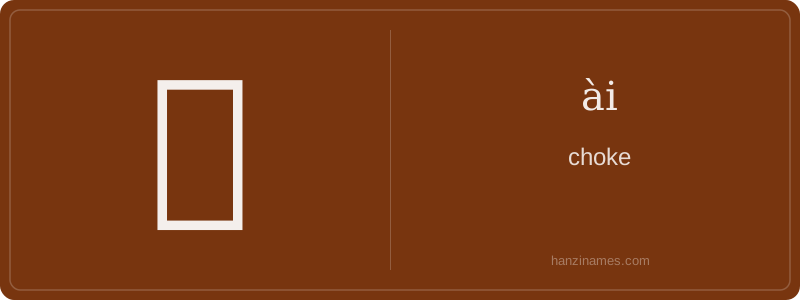
In contemporary Chinese, 嗌 is almost exclusively confined to formal medical writing and Classical Chinese texts — especially in Traditional Chinese Medicine (TCM) diagnoses. It appears in documented phrases like 嗌塞 (yì sāi, 'throat obstruction') and 嗌干 (yì gān, 'dry throat'), both cited in authoritative TCM references such as the *Huangdi Neijing* commentaries and modern textbooks like *Zhongyi Neike Xue*. Outside medicine, it’s vanishingly rare; no major idiom, song lyric, or social media trend features 嗌.
The character is not pictographic — no oracle bone or bronze script form survives. Its earliest attested form is in seal script (c. 3rd century BCE), already composed of 口 + 益. Rather than imagining ancient pictures, consider this real-life context: a TCM physician in Guangzhou writes 嗌干 on a patient’s chart to denote dry-throat syndrome linked to yin deficiency — a precise, non-colloquial notation understood only by trained practitioners.
Our detective begins at the scene: the character 嗌 appears in early Chinese medical texts as a specialized term for throat obstruction — not mere coughing, but a visceral, constricting blockage. Its radical 口 (mouth/throat) immediately signals bodily orality, while the phonetic component 益 (yì, 'to benefit') hints at an ancient linguistic paradox: something that *should* nourish (like food or breath) instead causes distress when obstructed. This duality — benefit turned barrier — surfaces in classical usage where 嗌 describes pathological constriction in the esophagus or larynx.
The character’s dual pronunciation (ài/yì) reflects its layered history: ài dominates modern Mandarin as the semantic reading for choking, while yì persists in literary and medical contexts, preserving the original phonetic value of 益. Unlike common characters with fluid evolution, 嗌 remained narrowly technical — rarely used outside clinical or classical discourse. Its thirteen strokes form a tight, vertical structure: 口 anchored at the top, 益 below, visually mirroring the anatomical path from mouth to pharynx.
Crucially, 嗌 is *not* a colloquial word. You won’t hear it in daily chatter — no one says ‘我嗌住了’ (‘I’m choking!’) in Beijing street talk. Instead, it appears in Tang dynasty medical compendia like the *Waitai Miyao*, and later in Qing-era diagnostic manuals describing ‘嗌塞’ (throat blockage) as a symptom of qi stagnation. Its rarity today makes it a linguistic fossil: precise, archaic, and deliberately preserved in Traditional Chinese Medicine (TCM) terminology rather than absorbed into vernacular speech.
Example Sentences
Common Compounds
Similar Characters — Don't Mix These Up
Your First Step into Chinese Culture: Get a Chinese Name
Every journey into Chinese begins with a name. Use our free Chinese name generator to create a meaningful, personalized Chinese name that fits you perfectly.
Get My Chinese Name →