嗑
Character Story & Explanation
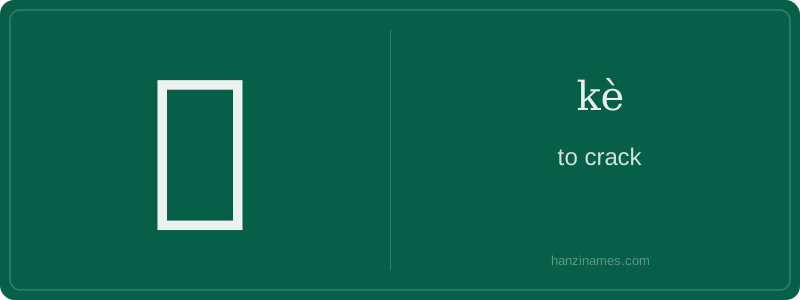
嗑 is overwhelmingly used in modern Mandarin for the physical act of cracking hard-shelled snacks—especially sunflower seeds (嗑瓜子)—a ubiquitous social ritual across China. It appears in documented idioms like 嗑瓜子聊闲天 (kè guāzǐ liáo xián tiān, 'crack seeds while chatting idly'), noted in sociolinguistic studies of informal communication. In Beijing opera scripts and Republican-era fiction (e.g., Lao She’s works), it marks character informality or working-class authenticity. It rarely appears in formal writing or classical texts.
The character is not pictographic nor attested in oracle bone or bronze inscriptions. Its earliest verified appearance is in late imperial vernacular literature (17th–18th c.), where it functions as a phono-semantic compound: 口 signals oral action, and 盍 (hé) provides approximate pronunciation (kè evolved via tone shift and dialectal influence). Today, you’ll hear it in snack shops, subway car conversations, and Douyin videos—always paired with crunching sounds and communal relaxation.
As an archaeologist sifting through layers of linguistic sediment, I uncover 嗑 not as a fossilized relic but as a living artifact of oral culture—its 口 (mouth) radical anchoring it firmly in the realm of sound and physical action. The right-hand component, 盍 (hé), originally depicted a lid covering a vessel, suggesting containment and release—a fitting metaphor for the controlled burst of force needed to crack shells with teeth. This character emerged not in bronze inscriptions but in vernacular texts, reflecting everyday acts long overlooked by elite scribes.
Excavating Ming and Qing dynasty vernacular novels reveals 嗑 as a phonetic-semantic compound born from colloquial speech. Unlike classical characters refined over centuries, 嗑 was forged in teahouses and street markets—places where sunflower seeds were cracked, gossip exchanged, and time passed in rhythmic, percussive mastication. Its 13 strokes map a kinetic gesture: tongue, jaw, and teeth coordinating like ancient artisans shaping clay—each stroke a measured pressure, each pause a breath before the next crack.
Modern excavations show 嗑 resisting standardization. Though absent from early HSK lists, it surged in digital corpora post-2000—appearing in chat logs, livestream captions, and snack packaging. Its persistence defies textbook hierarchies; it thrives not in dictionaries but in the mouths of students snacking during study breaks, elders on park benches, and influencers narrating seed-cracking ASMR videos. Here, language isn’t carved in stone—it’s cracked open, again and again, revealing kernels of shared humanity.
Example Sentences
Common Compounds
Similar Characters — Don't Mix These Up
Your First Step into Chinese Culture: Get a Chinese Name
Every journey into Chinese begins with a name. Use our free Chinese name generator to create a meaningful, personalized Chinese name that fits you perfectly.
Get My Chinese Name →