嗖
Character Story & Explanation
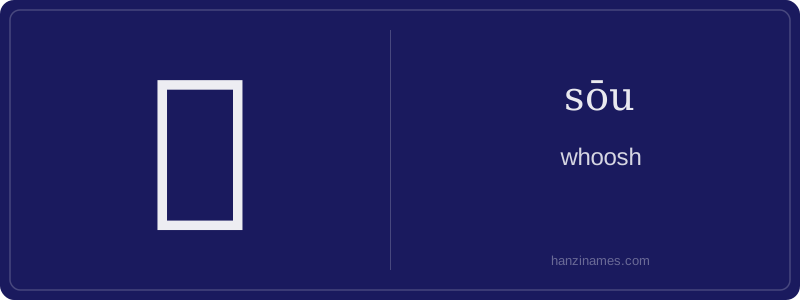
嗖 is overwhelmingly used in modern Mandarin as an onomatopoeic interjection or adverbial modifier describing rapid, linear motion with audible air displacement — especially in fiction, children’s literature, cartoons, and spoken narration. It appears in standardized textbooks (e.g., People’s Education Press Grade 4) and is frequently heard in animated dubbing (e.g., Pleasant Goat and Big Big Wolf). While no classical idiom contains 嗖 (it’s a late-developing character), it’s documented in early 20th-century vernacular fiction as part of the broader onomatopoeic expansion during the May Fourth Movement’s push for expressive, speech-based writing.
The character is not found in oracle bone or bronze inscriptions. Its earliest attestation is in Ming–Qing vernacular novels as a phonetic loan for the sound. Structurally, it combines 口 (radical, indicating sound production) with 搜 (sōu, ‘to search’) as phonetic component — a common pattern in phono-semantic compounds. Though 搜 contributes pronunciation, not meaning, the visual association subtly reinforces speed-as-exploration: ‘searching’ through space at velocity.
嗖 (sōu) is not a lexical word with abstract meaning, but a vivid onomatopoeic character — one of Chinese’s many ‘sound-shape’ glyphs that embody the language’s sensory philosophy. In traditional Chinese thought, sound is not separate from reality; it *is* a trace of movement, energy, or transformation. The ‘whooshing’ captured by 嗖 reflects qi (vital force) in rapid transit — like wind through bamboo, an arrow in flight, or time slipping away. This character invites learners to hear language as embodied experience, not just symbols.
Its radical 口 (mouth) signals vocalization and oral transmission — underscoring how Chinese culture values auditory immediacy: sounds are recorded *as they are heard*, not abstracted into phonemes. Unlike alphabetic systems that prioritize segmentation, Chinese onomatopoeia preserves holistic sonic texture. 嗖 doesn’t just name speed — it *re-enacts* it through rhythm and mouth shape (the open ‘o’ vowel mimics a sudden exhalation), revealing how language mirrors perceptual physics.
This character exemplifies the Confucian–Daoist harmony between form and function: every stroke serves acoustic fidelity. The 12 strokes — beginning with the mouth radical and ending in swift, descending strokes — visually echo motion itself. In calligraphy, skilled writers render the final two strokes with a flicking brush motion, physically enacting the ‘whoosh’. Thus, writing 嗖 becomes a micro-ritual of presence — aligning breath, hand, and sound — a quiet testament to China’s enduring belief that writing is embodied cosmology.
Example Sentences
Common Compounds
Similar Characters — Don't Mix These Up
Your First Step into Chinese Culture: Get a Chinese Name
Every journey into Chinese begins with a name. Use our free Chinese name generator to create a meaningful, personalized Chinese name that fits you perfectly.
Get My Chinese Name →