嗛
Character Story & Explanation
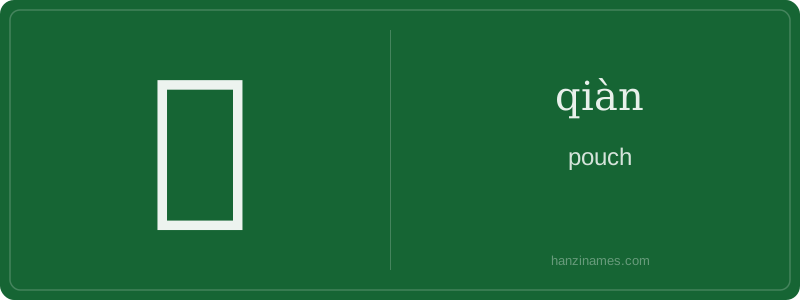
Historically, 嗛 appears in classical texts like the Shuōwén Jiězì (c. 121 CE), where Xu Shen defines it as 'a small pouch for holding things' (小嚢也), noting its use in Han dynasty contexts for carrying seals, medicines, or writing tools. It survives in fixed expressions like 嗛囊 (qiàn náng)—still cited in lexicographic references—but has no common idioms in modern Mandarin. Today, it’s virtually unused in speech or media; learners will not encounter it outside historical dictionaries or specialized philological study.
The character is not pictographic: its structure combines 口 (mouth radical, often phonetic here) and 欠 (qiàn, 'to lack', also phonetic), with no documented visual origin as a pouch. Instead, its form evolved phonetically—its pronunciation and meaning stabilized through usage, not depiction. In practice, contemporary Chinese speakers would use 袋 (dài), 包 (bāo), or 囊 (náng) instead.
The character 嗛 (qiàn) is a rare, archaic term meaning 'pouch'—specifically a small, soft, flexible container, often made of cloth or leather. Unlike modern words like 包 (bāo) or 袋 (dài), 嗛 carries connotations of intimacy and utility: think of a scholar’s ink pouch, a herbalist’s medicine bag, or a child’s embroidered sachet. Its rarity reflects how Chinese lexical evolution preserves functional nuance—retaining precise terms for culturally embedded objects even as they fade from daily use.
This character embodies the classical Chinese worldview that values material specificity and poetic economy: one character, one precise object, no redundancy. In pre-modern China, where resources were scarce and craftsmanship revered, naming a pouch wasn’t about generic containment—it was about honoring its purpose, texture, and ritual role—be it holding inkstones, aromatic herbs, or auspicious seeds. Thus, 嗛 subtly encodes respect for handmade objects and mindful consumption.
Though seldom written today, 嗛 lingers in literary memory and dialectal speech, especially in southern China and classical poetry. Its quiet persistence mirrors Confucian ideals of preserving cultural continuity—not through force, but through gentle retention. To encounter 嗛 is to glimpse a world where language itself was a vessel: holding meaning lightly, yet never letting it spill. It invites learners not just to memorize a character, but to pause and feel the weight—and softness—of intention behind every word.
Example Sentences
Common Compounds
Similar Characters — Don't Mix These Up
Your First Step into Chinese Culture: Get a Chinese Name
Every journey into Chinese begins with a name. Use our free Chinese name generator to create a meaningful, personalized Chinese name that fits you perfectly.
Get My Chinese Name →