嗝
Character Story & Explanation
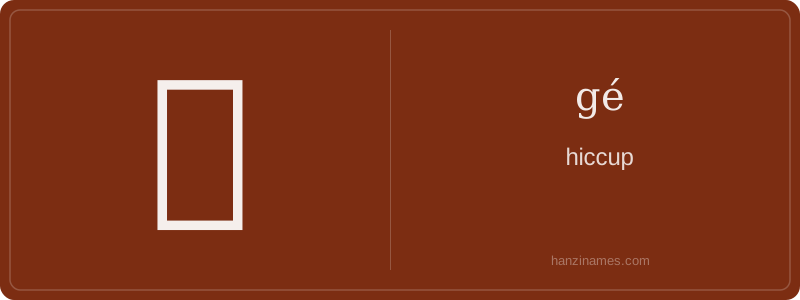
In modern Chinese, 嗝 is used almost exclusively as an onomatopoeic noun or verb for 'hiccup'—common in casual speech, pediatric contexts, and humorous writing. It appears in fixed phrases like 打嗝 (dǎ gé, 'to hiccup') and in health advisories (e.g., 'drinking too fast causes hiccups'). No classical idioms feature it; it’s absent from the Shuowen Jiezi (2nd c. CE), confirming its late vernacular origin.
The character is a phono-semantic compound: 口 (kǒu, 'mouth') signals semantic domain, while 隔 (gé) provides both pronunciation and conceptual nuance—'separation' evoking the diaphragm's abrupt, involuntary contraction. Its earliest verified usage appears in 17th-century vernacular novels like Water Margin, where characters 'hiccup after drinking wine'—a realistic, non-metaphorical bodily detail.
Unearthing 嗝 feels like brushing dust from a Han dynasty medical bamboo slip—its form is unmistakably vocal, its function physiological. The 口 (mouth) radical anchors it in the realm of sound and breath, while the right-hand component 隔 (gé, 'to separate') hints at a sudden, involuntary interruption in the respiratory flow. This isn’t poetic metaphor—it’s anatomical precision encoded in script: a diaphragmatic spasm that ‘separates’ exhalation from control.
Unlike oracle-bone characters rooted in pictorial mimicry, 嗝 emerged late—first reliably attested in Ming-Qing vernacular fiction and medical compendia like Bencao Gangmu. Its absence in early bronze inscriptions confirms it wasn’t a ritual or cosmological concept, but a colloquial bodily phenomenon given lexical weight as literacy spread among physicians and storytellers.
The 13-stroke structure reveals deliberate standardization: the 口 radical appears early (strokes 1–3), grounding meaning before the phonetic-semantic compound unfolds. Each stroke traces a functional logic—not artistic flourish, but diagnostic clarity. To write 嗝 is to map the hiccup’s anatomy: mouth onset, muscular barrier (隔), and abrupt release. It’s linguistics as clinical notation.
Example Sentences
Common Compounds
Similar Characters — Don't Mix These Up
Your First Step into Chinese Culture: Get a Chinese Name
Every journey into Chinese begins with a name. Use our free Chinese name generator to create a meaningful, personalized Chinese name that fits you perfectly.
Get My Chinese Name →