嗤
Character Story & Explanation
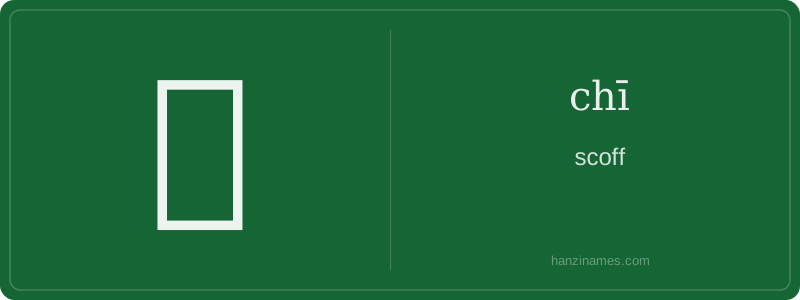
嗤 appears frequently in classical and modern written Chinese to express derisive laughter — especially in critiques of pretension, corruption, or empty rhetoric. A well-documented usage is in the idiom 嗤之以鼻 (chī zhī yǐ bí), meaning 'to snort at something in contempt', cited in authoritative dictionaries like the Xiandai Hanyu Cidian (7th ed., 2016) and widely used in editorials and literature. It’s also common in historical texts describing scholars’ reactions to absurd policies or flattery.
The character is not pictographic; its form evolved from seal script. The left 口 reflects its vocal nature, while the right component 斥 (chì) is phonetic *and* semantic — historically meaning 'to drive away' or 'to reprimand'. So 嗤 literally merges 'mouth' + 'rejection', a documented semantic-phonetic compound (形声字) confirmed by the Shuōwén Jiězì (c. 100 CE).
Hi students! Today we’re learning 嗤 (chī), a character that expresses a very specific kind of laughter — not joyful or friendly, but scornful, mocking, or dismissive. Think of a quick, sharp snort of disbelief or contempt. It’s not used for everyday chuckles; it’s literary and expressive, often appearing in writing or formal speech to show disdain. Because it carries strong emotional weight, it’s rarely used alone — usually as part of compound words or idioms.
The character has 口 (kǒu, 'mouth') as its radical, which makes sense: this kind of laugh comes from the mouth, but it’s not warm — it’s biting. Its right side, 斥 (chì), means 'to rebuke' or 'to斥 (scold/reject)', giving the whole character its critical, rejecting tone. This combination tells us that 嗤 isn’t just sound — it’s judgment made audible.
While you won’t hear 嗤 in casual chats like 'What’s for lunch?', you *will* see it in essays, news commentary, historical novels, or even social media posts criticizing hypocrisy. It’s a compact, powerful way to convey intellectual or moral dismissal — like saying 'pfft' with raised eyebrows and a loaded pause. Mastering it helps you read nuanced Chinese texts and express sophisticated attitudes precisely.
Example Sentences
Common Compounds
Similar Characters — Don't Mix These Up
Your First Step into Chinese Culture: Get a Chinese Name
Every journey into Chinese begins with a name. Use our free Chinese name generator to create a meaningful, personalized Chinese name that fits you perfectly.
Get My Chinese Name →