嗵
Character Story & Explanation
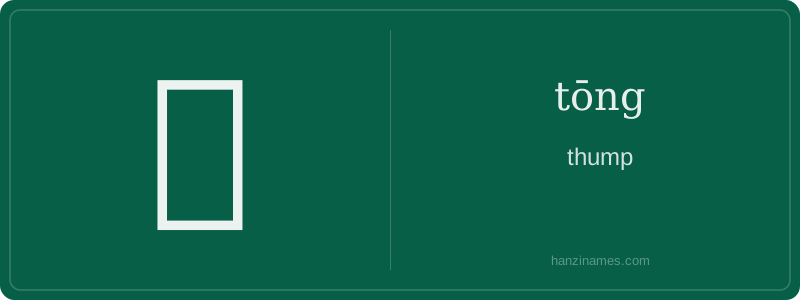
嗵 is almost exclusively used as an onomatopoeic interjection in modern Mandarin, representing a dull, heavy thumping sound—like a sack of rice hitting wood or someone falling off a stool. It appears in contemporary literature (e.g., Lao She’s later works), children’s books, and online forums; it is absent from Classical Chinese and pre-20th-century dictionaries. No standard idiom contains it, and it does not occur in formal registers. Its usage is consistently colloquial, expressive, and context-dependent.
The character is a phono-semantic compound: the left ‘mouth’ radical (口) signals it’s a sound-related word, while the right component ‘通’ (tōng) provides pronunciation only—it carries no meaning here. This is a documented case of phonetic loan (假借), common in modern onomatopoeic character creation. No pictographic origin exists; it was invented to meet a pragmatic need in spoken language transcription.
As an archaeologist sifting through layers of linguistic sediment, I find 嗵 not in oracle bones or bronze inscriptions—but in the living strata of modern spoken Chinese. This character is a latecomer: absent from classical texts and early dictionaries, it emerged organically in the 20th century as onomatopoeia crystallized into script. Its thirteen strokes—beginning with the ‘mouth’ radical 口—signal its origin as a vocalized sound, not a conceptual ideograph. It’s a fossil of auditory culture: the human impulse to transcribe impact noise into writing.
Unlike ancient characters carved for ritual or record, 嗵 was forged in vernacular speech—heard in alleyways, children’s stories, and cartoon sound effects. Its structure tells a story of phonetic borrowing: the right side ‘通’ (tōng) serves purely as a phonetic cue, lending pronunciation but no semantic weight. There’s no hidden cosmology here—no celestial harmony or moral virtue—just the blunt, physical truth of a heavy object hitting the floor. It’s linguistic fieldwork in real time: sound first, script second.
This character resists Confucian reverence. It doesn’t appear in poetry anthologies or calligraphy masterpieces. Instead, it lives in the margins: comic books, children’s literature, and digital messaging where users type ‘嗵’ to punctuate a fall, a drop, or a comedic thud. Its archaeological significance lies precisely in its humility—it reveals how Chinese writing continues evolving not through imperial decree, but through collective, everyday sonic need. A thump, made visible.
Example Sentences
Common Compounds
Similar Characters — Don't Mix These Up
Your First Step into Chinese Culture: Get a Chinese Name
Every journey into Chinese begins with a name. Use our free Chinese name generator to create a meaningful, personalized Chinese name that fits you perfectly.
Get My Chinese Name →