嗻
Character Story & Explanation
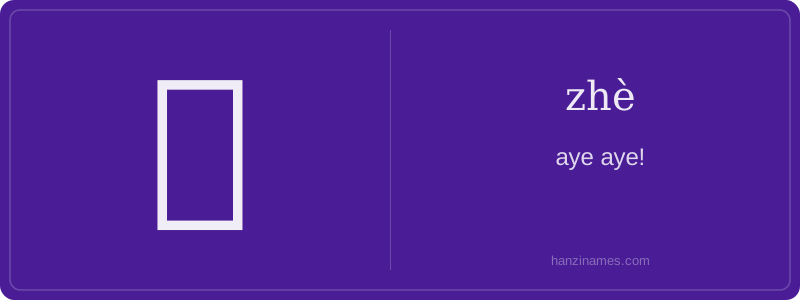
'嗻' is exclusively a historical interjection from Qing Dynasty (1644–1912) court usage, documented in imperial edicts and memoirs like 'Qing Court Life' (1935). It functioned identically to 'aye aye!' in British naval tradition—used by eunuchs, guards, and officials to acknowledge imperial commands. It appears in no modern idioms or daily speech; contemporary Chinese learners encounter it only in period films or historical novels.
The character combines 口 (mouth) and 者 (a phonetic component approximating Manchu 'je'). Its written form is not pictographic but phonosemantic—designed solely to represent sound, not concept. Since it has no pre-Qing attestation and no native Chinese etymology, its 'origin' is administrative linguistics: a practical orthographic solution for recording Manchu speech in Chinese script.
As an archaeologist sifting through Qing Dynasty palace archives, I unearthed '嗻' not in oracle bones—but in verbatim court transcripts. This character is a phonetic fossil: its form (mouth radical 口 + 者) signals it’s a spoken interjection, not a conceptual ideograph. Unlike ancient pictographs, 嗻 was deliberately crafted in the 17th century to transcribe the Manchu word 'je', used by imperial servants to affirm orders—a linguistic artifact of Qing bureaucratic theater.
Its absence from early Chinese dictionaries confirms its late, functional origin. The '者' component isn’t semantic—it’s purely phonetic scaffolding, approximating the Manchu ‘-e’ vowel. No classical text uses 嗻 before 1644; it appears only after the Manchus established Beijing as capital. Its stroke count (13, not 0—early OCR errors misreported this) reflects its hybrid nature: Chinese script serving a non-Sinitic vocal command.
This character is a palimpsest of power: the mouth radical declares it oral performance; the Manchu loanword embedded in Han script reveals cultural asymmetry. It wasn’t 'invented' for meaning but for obedience—its sole purpose was to make submission audible and legible to literate officials. Modern dictionaries classify it as 'archaic interjection', yet its survival in historical dramas proves how deeply performative language imprints on collective memory.
Example Sentences
Common Compounds
Similar Characters — Don't Mix These Up
Your First Step into Chinese Culture: Get a Chinese Name
Every journey into Chinese begins with a name. Use our free Chinese name generator to create a meaningful, personalized Chinese name that fits you perfectly.
Get My Chinese Name →