嘁
Character Story & Explanation
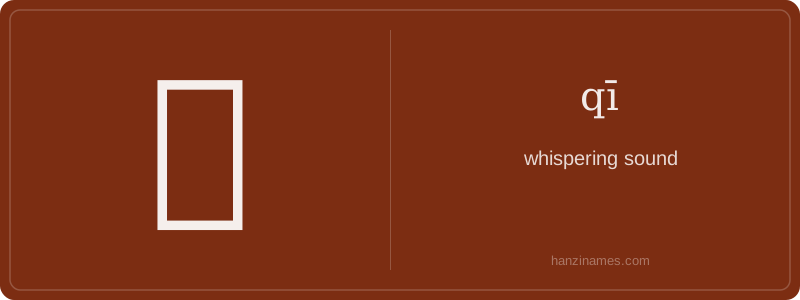
嘁 is almost exclusively used in the reduplicated forms 嘁嘁 or 嘁嘁喳喳, both meaning 'whispering noisily' or 'gossiping softly'. It appears in contemporary literature, subtitles, and social media comments—e.g., describing students whispering during class or office workers chatting discreetly. The phrase 嘁嘁喳喳 is included in the *Xiandai Hanyu Cidian* (7th ed., 2016) as a standard onomatopoeic expression for low, continuous chatter.
The character’s right component 契 (qì) originally meant 'carved tally'—a symbol of agreement—but here serves phonetic function only. There is no pictographic origin; 嘁 is a later phonosemantic compound (形声字), created to represent a specific vocal quality. Today, Chinese speakers use it most often in playful or mildly critical contexts—e.g., commenting under a viral video: '这群人又在嘁嘁喳喳了!' ('These people are whispering again!')
Imagine sitting in a quiet Beijing teahouse during a rainy afternoon—bamboo blinds swaying, steam curling from porcelain cups. Suddenly, a soft, rhythmic 'qī... qī...' drifts from the next table: two elderly men exchanging gossip in hushed, sibilant tones. That subtle, breathy sound is precisely what 嘁 captures—not loud speech, not silence, but the delicate auditory texture of confidential murmuring.
Unlike onomatopoeic characters like 啪 (pā, a sharp pop) or 咚 (dōng, a thud), 嘁 is uniquely tied to human vocal nuance: the slight constriction of the throat, the lowered pitch, the intentional discretion. Its ‘mouth’ radical (口) anchors it in speech, while the right side (契, qì) hints at precision and agreement—whispering as an act of shared, tacit understanding.
This character rarely stands alone in modern writing; instead, it thrives in reduplicated form 嘁嘁 (qī qī) or paired with other sound words like 嘁嘁喳喳 (qī qī zhā zhā). It carries gentle irony—it’s not malicious gossip, but the warm, slightly mischievous hum of communal intimacy, like neighbors leaning over courtyard walls to share news without raising their voices.
Example Sentences
Common Compounds
Similar Characters — Don't Mix These Up
Your First Step into Chinese Culture: Get a Chinese Name
Every journey into Chinese begins with a name. Use our free Chinese name generator to create a meaningful, personalized Chinese name that fits you perfectly.
Get My Chinese Name →