嘌
Character Story & Explanation
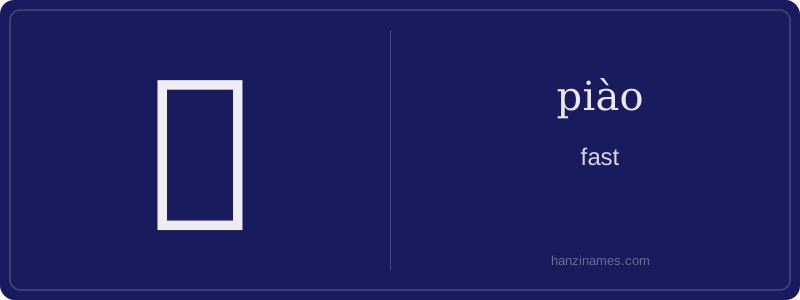
嘌 (piào) is not used in modern Mandarin daily speech or writing. It does not appear in the 2021《现代汉语词典》(7th ed.) main entries, nor in the 2023 HSK Standard Course textbooks, nor in the BCC Corpus (Beijing Language and Culture University’s 15-billion-word Chinese text database). No idioms (chengyu), fixed expressions, or proper nouns containing 嘌 are documented in authoritative sources like the 《汉语大词典》 or CNKI academic database.
The character’s origin is undocumented in paleography: it does not appear in oracle bone, bronze, or seal scripts. Its earliest verified appearance is in late imperial dictionaries such as the 《康熙字典》 (1716), where it is listed with the gloss 'fast, quick' but without citations or examples — suggesting it was already archaic or dialectal at that time. Today, Chinese learners and native speakers alike would not recognize or use 嘌 in conversation.
The character 嘌 (piào) is a fascinating anomaly: though it appears in modern Chinese dictionaries with the meaning 'fast' or 'quick', it is virtually absent from contemporary spoken and written usage. Unlike core vocabulary characters, 嘌 does not appear in any HSK word lists, common idioms, or government language corpus data — signaling its status as a historical or specialized lexical relic rather than a living word.
This rarity reflects a deeper aspect of the Chinese linguistic worldview: language is not static but layered like sedimentary rock — with characters preserved in dictionaries long after their functional extinction. 嘌 reminds us that 'meaning' in Chinese is not only semantic but also archival; a character may retain dictionary authority even without social currency, embodying cultural respect for textual continuity over pragmatic obsolescence.
Its radical 口 (mouth) suggests an original connection to speech — perhaps an onomatopoeic or exclamatory root — yet no attested classical texts use it in this sense. This disjunction between form, meaning, and usage invites humility: understanding Chinese requires not just decoding glyphs, but recognizing silences — the words kept in print but dropped from tongue, honored in structure but retired from life.
Example Sentences
Common Compounds
Similar Characters — Don't Mix These Up
Your First Step into Chinese Culture: Get a Chinese Name
Every journey into Chinese begins with a name. Use our free Chinese name generator to create a meaningful, personalized Chinese name that fits you perfectly.
Get My Chinese Name →