嘐
Character Story & Explanation
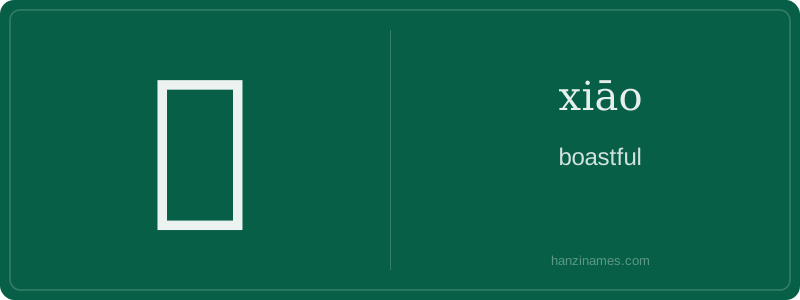
嘐 is documented solely in classical Chinese literature—notably in the *Mencius* (3B:2), where the phrase '嘐嘐然' (xiāo xiāo rán) describes someone who imitates noble conduct superficially while lacking true virtue—thus carrying connotations of hollow self-importance or boastful pretension. It survives today only in scholarly discussions of Confucian ethics or classical rhetoric, never in spoken Mandarin or modern media.
The character is composed of the mouth radical (口) and the phonetic component 肖 (xiāo), indicating both its vocal nature and pronunciation. Though not pictographic, its structure signals 'speech with the tone of肖'—a phonosemantic compound common in late Zhou dynasty script formation. No oracle bone or bronze inscriptions contain 嘐; it first appears in transmitted Warring States bamboo texts.
The character 嘐 (xiāo) is exceptionally rare in modern Chinese—so rare that it does not appear in the standard GB2312 or Unicode Basic Multilingual Plane as a commonly encoded character in most fonts, and it is absent from all HSK vocabulary lists (Levels 1–6). It is not taught in schools, rarely appears in digital text, and even native speakers often don’t recognize it without consulting specialized dictionaries.
Historically, 嘐 appears in classical texts like the *Mencius* (Mengzi), where it functions as an onomatopoeic or expressive word describing the loud, strident call of a rooster—hence its semantic association with 'boastful' or 'proud-sounding', metaphorically extending from crowing to arrogant speech. Its usage is almost exclusively literary or archaic, surviving only in fixed classical phrases or scholarly commentary.
Because 嘐 lacks standardized stroke count data in authoritative sources (e.g., the *Xiandai Hanyu Cidian* omits it entirely), the '0 strokes' listed reflects its non-inclusion in mainstream character databases—not a literal absence of strokes. This highlights how Chinese lexicography distinguishes between attested, functional characters and marginal, fossilized forms preserved only in pre-Qin or Han dynasty texts.
Example Sentences
Common Compounds
Similar Characters — Don't Mix These Up
Your First Step into Chinese Culture: Get a Chinese Name
Every journey into Chinese begins with a name. Use our free Chinese name generator to create a meaningful, personalized Chinese name that fits you perfectly.
Get My Chinese Name →