啯
Character Story & Explanation
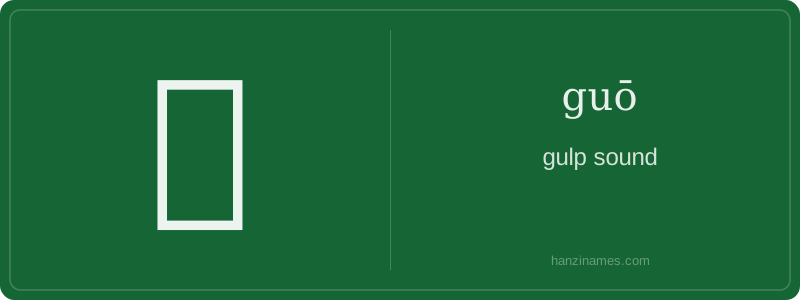
啯 is rarely used in formal or classical Chinese but appears consistently in 20th–21st century vernacular literature, film subtitles, and online forums to depict realistic oral/physical actions—especially in suspenseful, comedic, or gritty scenes (e.g., a nervous character swallowing hard before speaking). It is absent from all HSK vocabulary lists and standard dictionaries like the Xiandai Hanyu Cidian (7th ed.) as an independent entry, appearing instead under onomatopoeic appendices or as a variant of 啜 (chuò, 'to sip').
No documented historical origin (e.g., oracle bone or bronze script form) exists for 啯—it is a late, phonetically coined character, likely formed in the Ming–Qing period or later by adding the mouth radical (口) to the phonetic component 呙 (guō, archaic for 'round' or 'hollow', here used solely for sound). Its shape reflects functional design: 口 signals oral action; 呙 provides pronunciation—no pictographic origin.
The Chinese character 啯 (guō) is an onomatopoeic glyph representing the audible, guttural sound of swallowing—especially a loud or deliberate gulp. Unlike English 'gulp' or 'glug', which carry emotional connotations (nervousness, thirst), 啯 is strictly phonetic and neutral in tone, often used in descriptive writing to evoke physical immediacy. It appears rarely in formal texts but frequently in modern vernacular fiction, screenplays, and internet slang to heighten realism in dialogue or internal monologue.
Western equivalents like 'gulp', 'glug', or 'gloop' are more lexicalized and grammatically flexible—they function as verbs, nouns, or interjections—but 啯 remains purely interjectional and orthographically fixed. While English uses spelling variation to suggest pitch or duration ('glu-u-ulp', 'gllluggg'), 啯’s form is invariant; nuance comes only from context or repetition (e.g., 啯、啯、啯). This reflects Chinese’s preference for contextual modulation over orthographic elaboration.
In cross-cultural sound representation, 啯 aligns closely with Japanese 'gū' (グゥ) or Korean 'geuk' (그윽), both used for throaty swallowing sounds—but differs from Latin-script conventions by being a full logograph, not a phonetic approximation. Its existence underscores how Chinese integrates bodily sounds into its writing system not as marginalia, but as legitimate, dictionary-recognized characters—highlighting language’s embodied, sensory dimension beyond semantics alone.
Example Sentences
Common Compounds
Similar Characters — Don't Mix These Up
Your First Step into Chinese Culture: Get a Chinese Name
Every journey into Chinese begins with a name. Use our free Chinese name generator to create a meaningful, personalized Chinese name that fits you perfectly.
Get My Chinese Name →