唛
Character Story & Explanation
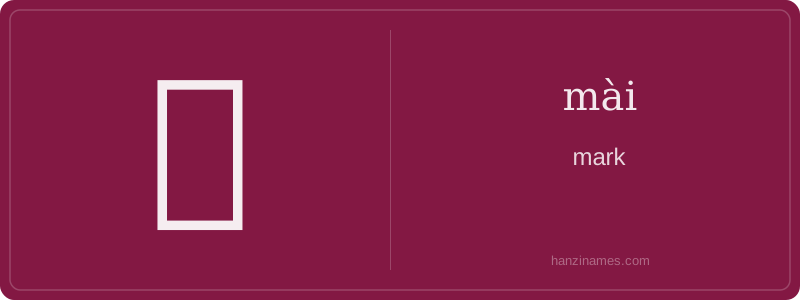
唛 is almost exclusively used in commercial and industrial contexts across Greater China—especially in Hong Kong, Guangdong, and Taiwan—to denote product labels, brand marks, or batch identifiers. It appears on packaging, customs forms, and warehouse inventories (e.g., '唛头' mài tóu = shipping mark). Though absent from HSK lists and classical texts, it's entrenched in logistics jargon and widely understood by professionals. No major idioms contain it, and it does not appear in pre-20th-century sources.
The character has no ancient origin: it’s a modern phono-semantic compound created in the early 1900s. The right component 麦 (mài, 'wheat') provides sound; 口 (mouth) indicates it’s a borrowed spoken term. In daily use, Chinese speakers say '这个货的唛是什么?' ('What’s the mark/label for this shipment?')—a real phrase heard in Shenzhen factories and Ningbo port offices.
Unearthing 唛 feels like brushing dust from a 19th-century shipping crate in Guangzhou’s old Whampoa docks—where Western trade terms first seeped into Chinese mercantile speech. This character isn’t ancient: it’s a phonetic loan, born not of oracle bones or bronze inscriptions, but of colonial-era transliteration. Its ‘mouth’ radical (口) signals it’s a *spoken* borrowing—not a native semantic invention—but rather a syllabic vessel for the English word 'mark' as used on cargo labels.
The ten strokes map precisely to the Cantonese pronunciation /maak⁶/, later standardized as Mandarin mài. Unlike classical characters that evolved pictographically, 唛 was deliberately coined in the late Qing to label goods—stamped on burlap sacks, steamship manifests, and factory invoices. Its form is functional: 口 anchors it as a linguistic import; the right side 麦 (wheat) was chosen purely for sound, not meaning—a silent echo of 'mark' filtered through southern Chinese phonology.
This character is archaeology of globalization: a lexical fossil preserving the moment when China’s treaty ports absorbed foreign commercial vocabulary without translation. It reminds us that not all Chinese characters tell agrarian or philosophical stories—some bear the smudge of ink-stamps, the grit of dockside sand, and the pragmatic urgency of 'this is the brand, this is the grade, this is the batch.' Its survival testifies to how trade reshapes language at the stroke level.
Example Sentences
Common Compounds
Similar Characters — Don't Mix These Up
Your First Step into Chinese Culture: Get a Chinese Name
Every journey into Chinese begins with a name. Use our free Chinese name generator to create a meaningful, personalized Chinese name that fits you perfectly.
Get My Chinese Name →