嘡
Character Story & Explanation
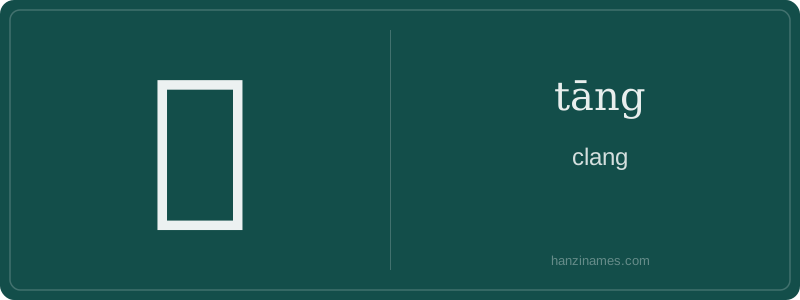
嘡 is almost exclusively used as an onomatopoeic interjection in modern Mandarin — especially in literature, comics, and oral storytelling — to represent a sudden, metallic 'clang!' It appears frequently in martial arts novels (e.g., Jin Yong’s works) and children’s books depicting blacksmiths, temple bells, or cartoonish collisions. Though rarely in formal writing, it’s instantly recognizable and widely taught in elementary Chinese phonetics units as a classic example of mouth-radical sound characters.
Visually, 嘚 is composed of the ‘mouth’ radical (口) on the left — signaling speech or sound — and the phonetic component 湯 (tāng, 'boiling water'), which provides pronunciation but no semantic link. This is a standard phono-semantic compound (形声字), not a pictograph; its origin lies in Tang–Song dynasty phonetic borrowing, not ancient pictorial representation.
The character 嘡 (tāng) is a vivid onomatopoeic glyph that captures the sharp, resonant sound of metal striking metal — like a gong, bell, or hammer hitting an anvil. In Chinese linguistic philosophy, sound and meaning are not abstractly separated; instead, characters like 嘡 embody the Daoist principle of *ming* (名, 'name') as a resonance with reality — the written form itself vibrates with the auditory experience it denotes.
This reflects a worldview where language is performative and sensory: to write 嘡 is to summon the clang — not merely describe it. Unlike English onomatopoeia (e.g., 'clang'), which remains phonetic but graphically arbitrary, 嘡 integrates sound (*tāng*), semantic hint (the ‘mouth’ radical 口 signals vocalization/sound emission), and visual rhythm — its structure mimics acoustic impact through repetition and symmetry.
Historically, such characters emerged alongside ritual bronze culture, where sonic precision mattered in ancestral rites and state ceremonies. The clang wasn’t noise — it was cosmological punctuation: marking transitions, summoning spirits, or asserting order. Thus, 嘡 carries quiet cultural weight — a tiny sonic ritual fossilized in ink, reminding readers that in Chinese thought, sound shapes reality, and writing preserves its echo.
Example Sentences
Common Compounds
Similar Characters — Don't Mix These Up
Your First Step into Chinese Culture: Get a Chinese Name
Every journey into Chinese begins with a name. Use our free Chinese name generator to create a meaningful, personalized Chinese name that fits you perfectly.
Get My Chinese Name →