嘣
Character Story & Explanation
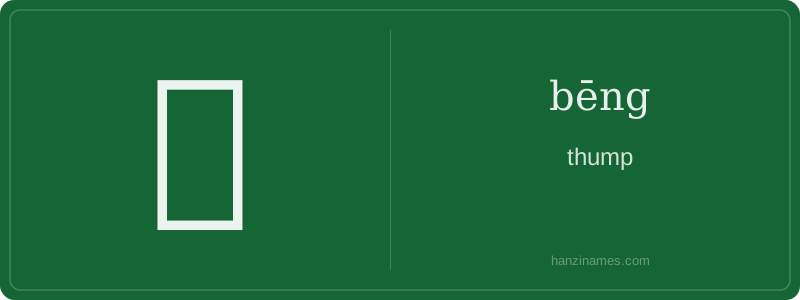
嘣 is almost exclusively used as an onomatopoeic interjection in modern Mandarin—never as a standalone verb or noun in formal writing. It appears frequently in children’s literature, comic books (manhua), and animated subtitles to depict sharp, hollow impacts: a drumbeat, a trapdoor dropping, or a cartoon character bonking their head. No classical texts or idioms feature 嘣; it’s absent from the Kangxi Dictionary and only entered mainstream dictionaries in the 20th century.
The character has no verified ancient origin—it is a modern phono-semantic compound, created by adding 口 to 崩 (bēng, 'to collapse') to emphasize auditory quality. Its form reflects linguistic engineering, not paleography. Today, Chinese speakers use it spontaneously in speech and digital messaging (e.g., “嘣!门关上了”) to add vivid, playful sound texture—like English ‘thump!’ or ‘boom!’ but with a drier, more staccato resonance.
As an archaeologist brushing dust from a Tang-dynasty bamboo slip, I found 嘣 not carved in oracle bone but inked in lively vernacular manuscripts—proof it emerged late, as onomatopoeia crystallized in spoken Chinese. Its radical 口 (mouth) signals vocal origin: this is not a concept, but a sound captured in script—a sonic fossil of impact and sudden release.
Unlike ancient ideographs depicting objects, 嘣 bears no pictorial ancestry. It is phonosemantic: the 口 hints at articulation, while the right side (崩) originally meant 'to collapse'—a semantic echo reinforcing abruptness, resonance, and rupture. This dual layer makes it a linguistic stratigraphy: mouth + collapse = the acoustic signature of something snapping, bursting, or thumping.
Its 14 strokes follow strict order—beginning with the mouth radical’s left vertical, then its enclosing frame—mirroring how oral sounds are first framed, then released. In Song-era storybooks and Ming opera scripts, 嘣 appears repeatedly in stage directions, marking percussive moments: a door slamming, a rope snapping, a firecracker detonating. It is less ‘written’ than *performed* on the page.
Example Sentences
Common Compounds
Similar Characters — Don't Mix These Up
Your First Step into Chinese Culture: Get a Chinese Name
Every journey into Chinese begins with a name. Use our free Chinese name generator to create a meaningful, personalized Chinese name that fits you perfectly.
Get My Chinese Name →