嘧
Character Story & Explanation
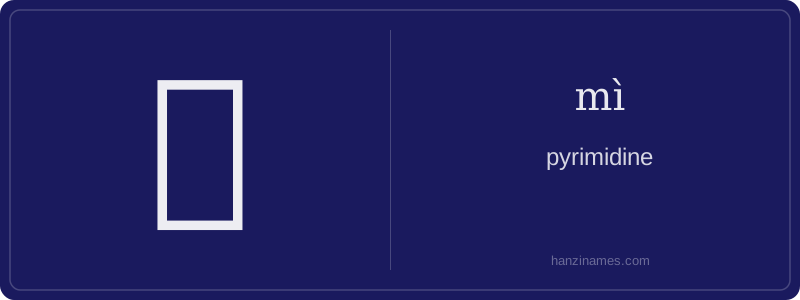
嘧 is almost exclusively used in scientific and medical contexts in contemporary Chinese—especially in biochemistry, pharmacology, and genetics. It appears in standardized textbooks (e.g., 《生物化学》), national drug nomenclature (e.g., 国家药品监督管理局 approved names), and research papers. No idioms, proverbs, or literary works feature 嘧; it has no colloquial usage. Its presence signals technical precision—not everyday communication.
The character was created in the 1930s–40s by the Committee for the Unification of Scientific Terminology, which systematically coined characters for organic compounds. As a phonosemantic compound, 嘧 combines 口 (semantic, indicating 'name/sound') and 密 (mì, phonetic, also meaning 'dense, tight')—chosen for sound match with 'pyri-mi-dine', not meaning. Its form has no ancient origin; it is a deliberate, modern neologism.
The character 嘧 (mì) embodies China’s pragmatic integration of global scientific knowledge into its linguistic framework. Unlike ancient characters rooted in nature or ritual, 嘧 is a modern phonosemantic compound—crafted in the early 20th century to translate Western biochemical terminology. Its ‘mouth’ radical (口) signals it as a *name*—not an action or object—but a lexical vessel for precise, foreign-derived concepts. This reflects a worldview where language is a living tool: adaptable, collaborative, and rigorously functional.
Its creation mirrors China’s broader scientific modernization: during the Republican era and later the PRC’s standardization campaigns, committees of linguists and scientists co-designed characters like 嘧 to render terms such as 'pyrimidine' without transliteration chaos. The choice of 口 underscores that science enters Chinese discourse not silently, but *through speech and naming*—a cultural emphasis on articulation as the first step toward understanding.
While not found in classical texts or poetry, 嘧 appears in pharmacology journals, university biochemistry syllabi, and drug regulatory documents—quietly anchoring life-saving knowledge. Its existence affirms a Confucian-tinged ideal: that wisdom must be *nameable* (正名, zhèng míng) before it can be taught, applied, or ethically governed. Thus, 嘧 is more than a syllable—it’s a testament to language as disciplined stewardship of human knowledge.
Example Sentences
Common Compounds
Similar Characters — Don't Mix These Up
Your First Step into Chinese Culture: Get a Chinese Name
Every journey into Chinese begins with a name. Use our free Chinese name generator to create a meaningful, personalized Chinese name that fits you perfectly.
Get My Chinese Name →