嘻
Character Story & Explanation
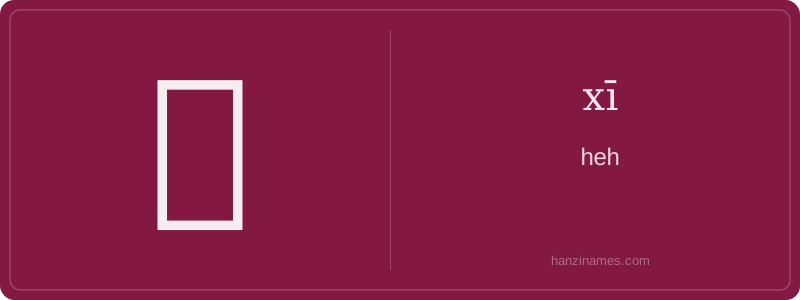
嘻 is overwhelmingly used today as an interjection expressing mild amusement, irony, or playful disbelief—never as a standalone verb meaning 'to laugh'. It appears frequently in dialogue in novels, web fiction, and subtitles (e.g., 嘻,真敢说! 'Heh, you really dare say that!'). While not in any HSK word list, it’s widely recognized by HSK 3+ learners due to its high frequency in informal contexts. No classical idiom features 嘻 as a core element; it rarely appears in formal writing or set phrases.
The character is a phonosemantic compound: 口 (kǒu, 'mouth') is the semantic radical, indicating vocalization; 喜 (xǐ, 'joy') is the phonetic component, approximating pronunciation and reinforcing emotional tone. Its earliest confirmed usage is in Tang dynasty poetry and anecdotal literature as an expressive particle—not a verb—and this function remains unchanged today.
As an archaeologist sifting through layers of linguistic sediment, I find 嘻 not in oracle bones—but in the resonant echo of human breath. Its radical 口 (mouth) anchors it firmly in vocal expression, while the phonetic component 喜 (xǐ, 'joy') signals its sonic and semantic kinship with delight. This is not a pictograph of laughter, but a carefully constructed phonosemantic compound: mouth + joy = the audible exclamation of amusement.
The character first appears reliably in early medieval texts—not as a verb meaning 'to laugh', but as an interjection: a spontaneous, light-hearted 'ha!' or 'heh!'. Unlike 笑 (xiào), the formal verb for 'laugh', 嘻 occupies the realm of paralanguage—what linguists call 'vocal gestures'. It marks tone, softens criticism, or punctuates irony, much like English 'well...' or 'oh, come on!'
Its fifteen strokes form a rhythmic balance: four for the 口 frame, eleven for the intricate 喜-derived right side. The brushwork invites hesitation—especially the double 'dot' strokes atop 喜—suggesting the staccato, almost giggling quality of the sound itself. In paleographic terms, 嘻 is less a fossilized relic and more a living artifact: unchanged in form for over 1,400 years, yet vibrantly functional in modern speech and writing.
Example Sentences
Common Compounds
Similar Characters — Don't Mix These Up
Your First Step into Chinese Culture: Get a Chinese Name
Every journey into Chinese begins with a name. Use our free Chinese name generator to create a meaningful, personalized Chinese name that fits you perfectly.
Get My Chinese Name →