噍
Character Story & Explanation
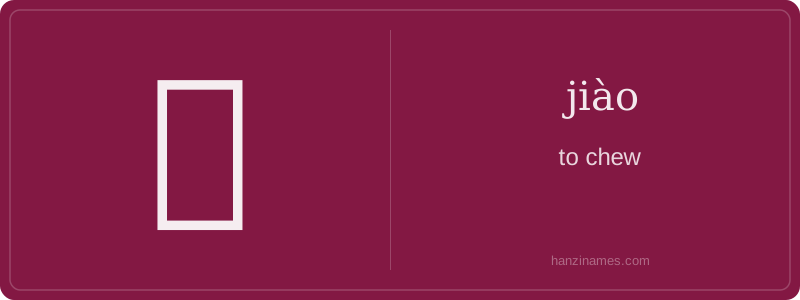
噑 is rare in modern Standard Mandarin but preserved in literary and regional usage — notably in Classical Chinese poetry and southern dialects (e.g., Min Nan and Hakka), where it appears in verbs like 噍噑 (jiào jiào) meaning 'to chew noisily' or 'to mutter while chewing'. It appears in the 12th-century Song dynasty text *Jiě Lǎo* (Commentary on the Laozi) describing bodily functions metaphorically, and in Ming-Qing vernacular novels for vivid oral imagery. Today, it’s mostly encountered in edited classical texts or linguistic studies, not everyday speech.
The character is not a pictograph but a phono-semantic compound: 口 (kǒu, 'mouth') is the semantic component, and 風 (fēng, 'wind') serves as the phonetic component — though the modern pronunciation jiào diverges from fēng due to historical sound shifts. There’s no oracle-bone or bronze script form attested; it first appears reliably in late medieval dictionaries like the *Yùpiān* (6th c. CE). In practice today, most native speakers recognize it only from context or study — not daily use.
Hi students! Today we’re learning 噍 (jiào), a less common but vivid character meaning 'to chew' — especially with force, emphasis, or even grumbling. It’s built around the mouth radical 口, showing it’s about oral action, and the right side 風 (fēng, 'wind') hints at sound or movement — like noisy chewing or muttering. Though not in daily conversational use, it appears in literary, poetic, or dialectal contexts to add texture and physicality to speech or eating.
This character is rarely used alone; it almost always appears in compound words or fixed expressions. Unlike more common synonyms like 咀嚼 (jǔjué) — formal 'mastication' — 噍 carries a slightly rustic, visceral, or even humorous tone. Think of it as the 'chomping' or 'chewing with attitude' version of 'chew'. Its rarity means you won’t find it on HSK lists (it’s beyond HSK 6), but recognizing it helps deepen your reading of classical poetry or regional literature.
Don’t confuse 噍 with similar-sounding or -looking characters — its pronunciation jiào is shared with 叫 ('to shout') and 教 ('to teach'), but the meaning is entirely different. Since it’s not taught in standard textbooks, treat it like a 'cultural bonus character': notice it when you see it, appreciate its mouthy energy, and remember that Chinese writing often uses radicals like 口 to anchor meaning in bodily experience — here, literally *mouth-in-motion*.
Example Sentences
Common Compounds
Similar Characters — Don't Mix These Up
Your First Step into Chinese Culture: Get a Chinese Name
Every journey into Chinese begins with a name. Use our free Chinese name generator to create a meaningful, personalized Chinese name that fits you perfectly.
Get My Chinese Name →