咝
Character Story & Explanation
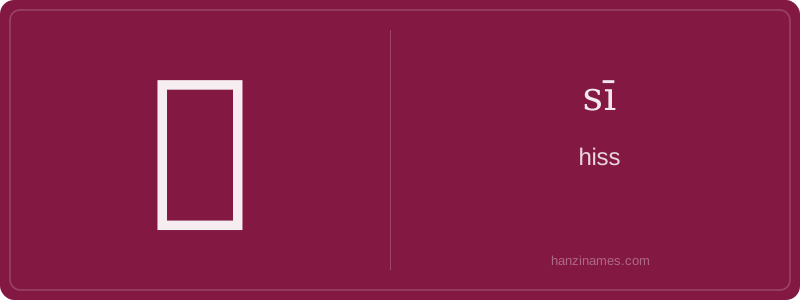
咝 is widely used in modern Chinese fiction, film subtitles, and online forums to transcribe sharp, sustained sibilant sounds — especially in action, horror, or animation contexts. It appears in well-known descriptive phrases like '咝的一声' (sī de yī shēng, 'a hissing sound') and is standard in children's books illustrating animal sounds. Though absent from classical texts due to its late emergence as a specialized onomatopoeia, it gained traction in 20th-century vernacular literature and is now codified in dictionaries like the Xiandai Hanyu Cidian (7th ed., 2016).
The character is not ancient: it’s a relatively modern creation (post-Qing dynasty), formed by combining 口 (mouth/sound) with three stacked 厶 (sī) components — themselves simplified forms of 私 (private), but here repurposed purely for phonetic reinforcement. Its design prioritizes auditory mimicry over pictorial origin; no oracle bone or bronze script precursors exist. Today, Chinese speakers use it instinctively when typing chat messages describing sudden sounds — e.g., '轮胎漏气了,咝——!' (‘Tire’s deflating — sssss!’).
The Chinese character 咝 (sī) is an onomatopoeic glyph that vividly captures the sharp, sibilant sound of hissing — like steam escaping a kettle, a snake warning intruders, or air leaking from a tire. Its eight strokes form a compact, repetitive structure centered around the mouth radical 口, emphasizing vocalization and sound production. Unlike English 'hiss', which is abstractly spelled, 咝 visually echoes its auditory function through repetition: the three 's'-like components (厶) stacked beneath 口 suggest layered, continuous friction — a brilliant example of Chinese phonetic-ideographic synthesis.
This character belongs to a class of expressive reduplicative onomatopoeias in Chinese, where repeated elements enhance sensory impact. While not part of the HSK curriculum (HSK Level: Not included), it appears frequently in literature, comics, and spoken descriptions to heighten realism and atmosphere. Learners encounter it more often in creative writing than in formal exams — think of suspenseful novels describing a serpent’s approach or sci-fi scenes with malfunctioning machinery.
In Western cultural equivalents, 'hiss' carries strong connotative weight: it signals danger (snakes), disdain (audience disapproval), or mechanical failure (leaking pressure). Similarly, 咝 evokes tension and immediacy in Chinese narratives — yet it lacks the moral judgment sometimes attached to English 'hiss' (e.g., 'hissing with envy'). Instead, it remains primarily acoustic and neutral, used descriptively rather than morally — closer to German 'zischen' or Japanese 'shii' in functional tone.
Example Sentences
Common Compounds
Similar Characters — Don't Mix These Up
Your First Step into Chinese Culture: Get a Chinese Name
Every journey into Chinese begins with a name. Use our free Chinese name generator to create a meaningful, personalized Chinese name that fits you perfectly.
Get My Chinese Name →