哝
Character Story & Explanation
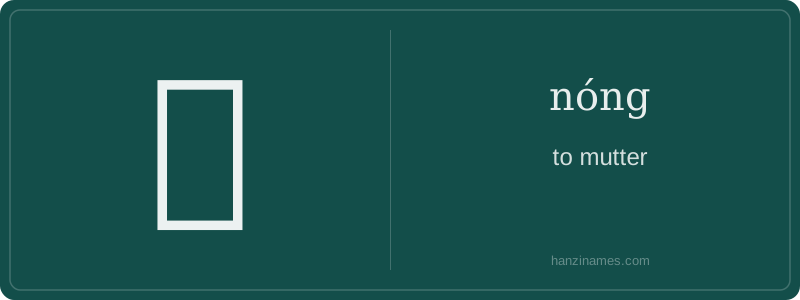
哝 is rarely used in formal writing or standardized tests (it is not included in the HSK syllabus at any level), but appears frequently in modern Chinese literature and subtitles to convey hushed, grumbling, or reluctant speech—especially in dialogue. It commonly appears in phrases like ‘小声哝哝’ (xiǎoshēng nóngnong), meaning 'to mutter softly', and serves as a stylistic alternative to 更多 common verbs like 说 (shuō) or 嘀咕 (dīgu). Notably, it features in contemporary novels by authors such as Wang Shuo and in subtitled adaptations of regional dramas where characters express discontent sotto voce.
The character is a phono-semantic compound: 口 (kǒu, 'mouth') signals its semantic field, while 弄 (nòng) provides approximate phonetic guidance—though the tone differs (nòng → nóng). Its form shows no pictographic origin; it evolved in printed vernacular texts of the late imperial period, not ancient inscriptions. Today, Chinese speakers use it most often in written dialogue to add tonal nuance—e.g., indicating a character rolling their eyes while muttering under their breath.
As an archaeologist sifting through layers of linguistic sediment, I uncover 哝 not in oracle bones or bronze inscriptions—but in the quiet, living strata of modern Mandarin speech. This character resists ancient grandeur; it emerged late, likely during the Ming or Qing dynasties, as a phonetic-semantic compound designed to capture the low, indistinct vocalizations humans make when speaking under breath, in frustration, or in private thought. Its radical 口 (mouth) anchors it firmly in the domain of speech, while the phonetic component 弄 (nòng) hints at manipulation—suggesting speech that is *handled*, *fumbled*, or *muffled* rather than projected clearly.
The character’s nine strokes form a compact, slightly asymmetrical structure: three horizontal lines above the mouth, then a downward stroke and looping curve—mirroring the physical constriction of lips and tongue during mumbling. Unlike pictographs carved for ritual permanence, 哝 was forged for immediacy: a scribbled annotation in a Ming-era novel margin, a stage direction in Kunqu opera scripts, or a whispered aside in Qing vernacular fiction. Its absence from early dictionaries like the Shuōwén Jiězì confirms its status as a later lexical innovation—not a relic, but a linguistic tool refined by everyday need.
What makes 哝 archaeologically fascinating is its resistance to standardization. It appears variably in regional texts—sometimes with 弄, sometimes with other phonetics—and even today, it remains marginal in formal writing, thriving instead in dialogue tags, literary narration, and dialect-influenced prose. Its survival testifies not to imperial decree, but to the persistent human impulse to transcribe the unspoken: the sigh before speech, the protest too soft for authority, the murmur that escapes conscious control. In this sense, 哝 is less a character than a fossilized breath—a trace of vocal hesitation preserved in ink.
Example Sentences
Common Compounds
Similar Characters — Don't Mix These Up
Your First Step into Chinese Culture: Get a Chinese Name
Every journey into Chinese begins with a name. Use our free Chinese name generator to create a meaningful, personalized Chinese name that fits you perfectly.
Get My Chinese Name →