噭
Character Story & Explanation
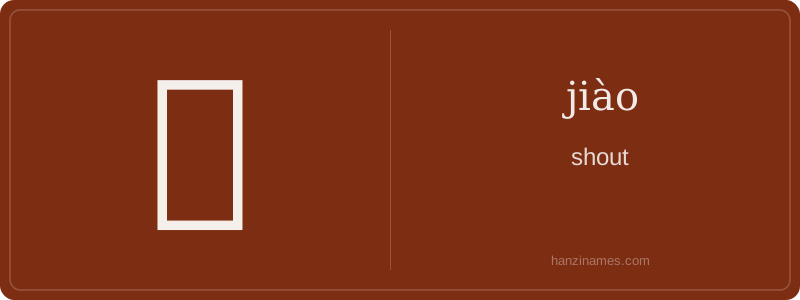
噭 is scarcely used in contemporary spoken Mandarin and does not appear in any HSK level. It survives primarily in classical texts, historical documents, and formal literary compositions—for example, in the *Book of Rites* (*Lǐjì*) and Qing-dynasty poetry, where it denotes impassioned or ritualistic vocalization. Modern usage is almost exclusively stylistic: writers may choose 噭 over 叫 to lend gravity or antiquity to dialogue or narration. No major idioms contain 噭; it appears solo or in fixed classical phrases like '噭然長嘯' ('shout forth a long, resonant whistle').
The character combines 口 (mouth) and 喬 (tall, lofty), reflecting its meaning through semantic-phonetic construction—not pictographic origin. The mouth radical signals vocal action, while 喬 serves both phonetic (approximating jiào) and suggestive roles, implying a voice rising high and far. Today, Chinese learners encounter it mainly in classical reading courses or textual analysis, not daily conversation.
The Chinese character 噭 (jiào) is a relatively rare, literary term meaning 'to shout' or 'to cry out loudly.' Unlike the more common 叫 (jiào), which is used in everyday speech for calling or shouting, 噭 carries an archaic, emphatic, or poetic tone—often appearing in classical texts, historical narratives, or stylized modern writing to evoke intensity, urgency, or dramatic vocalization. Its usage suggests a forceful, unrestrained vocal emission, closer to a roar or bellow than a casual call.
Etymologically, 噭 belongs to the mouth radical (口) category, indicating its semantic connection to speech or sound. Though not part of the modern HSK curriculum, it appears in classical dictionaries like the *Shuōwén Jiězì* (c. 100 CE), where it is defined as 'shouting with great force' (呼聲也). Its phonetic component 喬 (qiáo) hints at pronunciation but also subtly conveys elevation or height—reinforcing the idea of a voice projecting upward and outward with power.
In cross-cultural comparison, 噭 aligns less with routine English verbs like 'say' or 'call' and more with dramatic equivalents such as 'bellow,' 'roar,' or 'bawl'—terms that emphasize volume, emotion, and physical exertion. Western equivalents include the Greek *kraugē* (a loud cry in Homeric epics) or the Latin *clamare*, both reserved for heightened rhetorical or narrative moments. Like these, 噭 is rarely used in neutral contexts; instead, it marks pivotal emotional or climactic scenes in literature and historical records.
Example Sentences
Common Compounds
Similar Characters — Don't Mix These Up
Your First Step into Chinese Culture: Get a Chinese Name
Every journey into Chinese begins with a name. Use our free Chinese name generator to create a meaningful, personalized Chinese name that fits you perfectly.
Get My Chinese Name →