哙
Character Story & Explanation
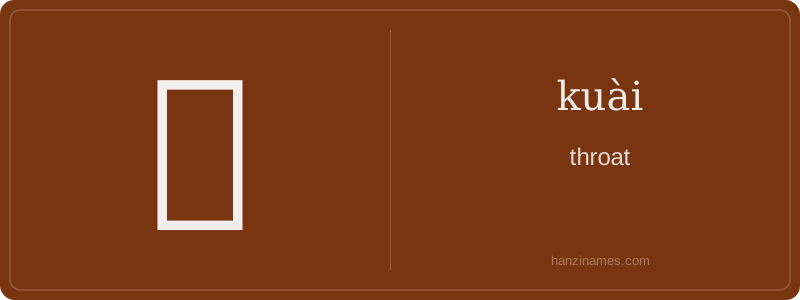
哙 is virtually absent from modern spoken Chinese and does not appear in any HSK level. It occurs only in pre-Qin and Han dynasty texts—most notably in the *Records of the Grand Historian* (Shǐjì), where it appears in the famous phrase '哙曰' (Kuài yuē), introducing speech by Fan Kuai, a loyal general of Liu Bang. Though 'Fan Kuai' is his name, the character 哙 here is part of his personal name, not used independently for 'throat' in that context. As a semantic character meaning 'throat', it survives only in rare classical compounds and historical linguistic studies.
The character is a phono-semantic compound: 口 (kǒu, 'mouth') as the radical indicates oral/throat-related meaning, and 会 (huì, 'to gather, meet') provides phonetic approximation (ancient pronunciation likely closer to *kʷˤrəp*). No pictographic origin exists—it evolved through seal script standardization, not oracle-bone depiction.
哙 (kuài) is a relatively rare Chinese character primarily meaning 'throat'—specifically the pharynx or upper airway passage. Unlike common anatomical terms like 咽 (yān, 'pharynx') or 喉 (hóu, 'larynx'), 哙 appears mostly in classical and literary contexts, not modern spoken Mandarin. Its usage is highly specialized, often evoking poetic or archaic diction, and it rarely appears in everyday vocabulary or HSK textbooks.
The character’s secondary pronunciation wèi is even more obscure and limited to ancient texts, such as certain editions of the *Zuo Zhuan* or early medical manuscripts, where it may denote a variant phonetic reading or dialectal form. Neither pronunciation is taught in standard Mandarin courses, and neither appears in the HSK syllabus—reflecting its marginal status in contemporary language education and communication.
In Western anatomy, 'throat' is a functional umbrella term covering both pharynx and larynx, but English lacks a single word that maps precisely to 哙’s narrow, classical sense. Compare it to Latin *faux* (archaic for 'throat', used only in poetry) or Greek *pharynx* (technical but widely adopted in medicine)—both are precise yet removed from daily speech, much like 哙 in modern Chinese.
Example Sentences
Common Compounds
Similar Characters — Don't Mix These Up
Your First Step into Chinese Culture: Get a Chinese Name
Every journey into Chinese begins with a name. Use our free Chinese name generator to create a meaningful, personalized Chinese name that fits you perfectly.
Get My Chinese Name →