咛
Character Story & Explanation
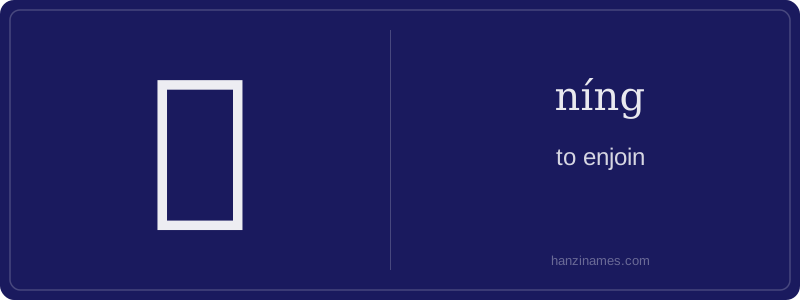
咛 is almost exclusively used in the compound 叮咛 (dīngníng), meaning ‘to enjoin earnestly’ or ‘to remind repeatedly with concern’. This term appears frequently in formal writing, official notices, parental advice, and literary descriptions — for example, government health advisories may say ‘请医生再三叮咛患者注意休息’ (Doctors repeatedly urged patients to rest). It’s also common in classical-influenced prose and modern essays discussing care or responsibility.
The character 咛 itself has no independent oracle-bone or bronze script attestation. It evolved as a phonosemantic compound: 口 (semantic, indicating speech) + 宁 (níng, phonetic, originally meaning ‘peace’ but here serving mainly for sound). Its modern usage reflects a linguistic pattern where gentle imperatives are doubled (like 叮咛, 嘱咐) to express sincerity and persistence — a real-life feature of Chinese communicative style.
Hi students! Let’s learn 咛 (níng) — a gentle but meaningful character. It belongs to the ‘mouth’ (口) radical family, so it’s related to speech or vocal expression. Though it looks simple with only 8 strokes, its core meaning is ‘to enjoin’ — that is, to urge, advise, or gently instruct someone, often with care and repetition. Think of a parent softly reminding a child: ‘Be careful!’ or ‘Don’t forget your coat!’ — that warm, persistent tone is exactly what 咛 conveys.
This character isn’t used alone in modern Mandarin — it almost always appears in reduplicated form (e.g., 叮咛) or as part of compound words. Its sound ‘níng’ carries a soft, lingering quality, matching its semantic nuance of repeated, heartfelt instruction. Unlike stronger verbs like 命令 (mìnglìng, ‘to order’), 咛 implies kindness and concern — not authority or force.
As a beginner, don’t worry about memorizing 咛 in isolation. Instead, learn it within high-frequency phrases like 叮咛 (dīngníng), which appears in textbooks, news reports, and everyday speech. Notice how the mouth radical (口) anchors it visually and semantically — every time you see 口 on the left, ask: ‘Is this word about speaking, calling, or sounding?’ That habit will help you decode dozens of characters!
Example Sentences
Common Compounds
Similar Characters — Don't Mix These Up
Your First Step into Chinese Culture: Get a Chinese Name
Every journey into Chinese begins with a name. Use our free Chinese name generator to create a meaningful, personalized Chinese name that fits you perfectly.
Get My Chinese Name →