嚅
Character Story & Explanation
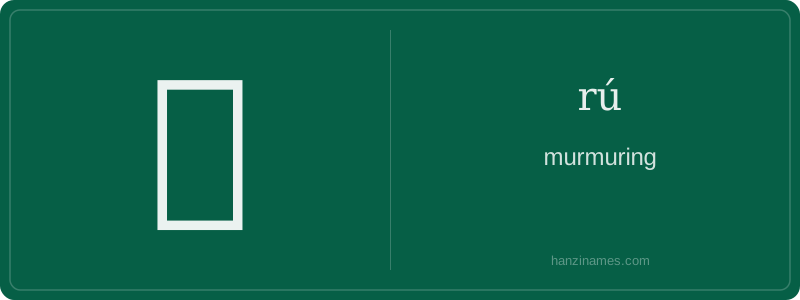
嚅 is rarely used alone in modern Mandarin; it appears almost exclusively in the compound 嚅嚅 (rú rú), meaning 'to mumble hesitantly' or 'to stammer softly'. It appears in literary and formal registers—not daily slang—but is documented in 20th-century modernist literature (e.g., Lu Xun’s disciples’ prose) to depict psychological tension, shame, or deference. It’s also found in classical-inspired idioms like 嚅嚅诺诺 (rú rú nuò nuò), describing timid, non-confrontational compliance—echoing Confucian expectations of junior members in family or workplace hierarchies.
The character is a phono-semantic compound: 口 (kǒu, 'mouth') is the semantic radical, clearly indicating speech-related meaning; the phonetic component is 需 (xū), which historically meant 'to wait for rain' (in oracle bones) but here serves primarily for sound (rú shares phonetic lineage with xū via Middle Chinese *ȵiɪu). No pictographic origin exists—it evolved graphically during the seal script era as a standardized compound, not a visual depiction.
嚅 (rú) embodies a subtle yet culturally resonant aspect of Chinese communication: the quiet, hesitant, almost involuntary movement of the lips—neither full speech nor silence. In Confucian-influenced society, where harmony and restraint are valued, 嚅 captures the liminal space between thought and utterance, reflecting a worldview that honors intentionality over volume. It’s not mere babbling; it’s the physical trace of inner hesitation, vulnerability, or suppressed emotion—making it linguistically intimate and psychologically precise.
This character reveals how Chinese perception often locates meaning in micro-gestures rather than grand declarations. Unlike English words that emphasize content ('mutter', 'stammer'), 嚅 foregrounds the *bodily act*—the quivering lips—as the primary signifier. The mouth radical (口) anchors it firmly in embodied expression, while the right component (需, xū, meaning 'to need' or 'to await') subtly suggests speech held in abeyance, waiting for permission, courage, or appropriateness—a reflection of hierarchical and context-sensitive social norms.
Thus, 嚅 is more than phonetic description; it’s a cultural lens into the Chinese valuation of restraint, face (miànzi), and the unspoken. Its use implies empathy—the listener must read between the lip movements—and signals that true understanding lies not in what is said, but in why it remains half-formed. This aligns with Daoist and literary traditions where silence and near-speech often carry deeper resonance than eloquence, revealing a worldview where subtlety, timing, and self-restraint are marks of wisdom.
Example Sentences
Common Compounds
Similar Characters — Don't Mix These Up
Your First Step into Chinese Culture: Get a Chinese Name
Every journey into Chinese begins with a name. Use our free Chinese name generator to create a meaningful, personalized Chinese name that fits you perfectly.
Get My Chinese Name →