嚗
Character Story & Explanation
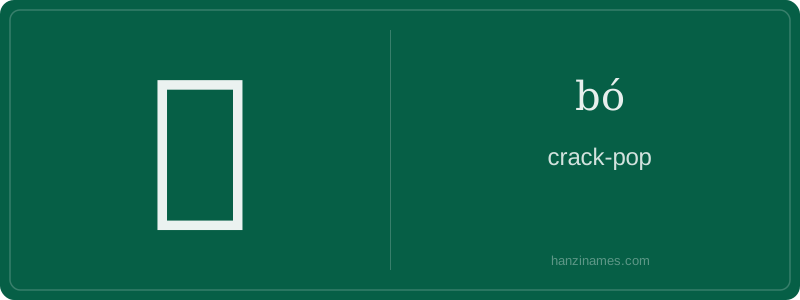
嚗 (bó) appears almost exclusively in reduplicated or paired onomatopoeic expressions such as 噼嚗 (pībó) and 嚗嚗 (bóbó), commonly found in classical poetry, modern fiction, and descriptive narration — especially when evoking fire crackling, lightning, or sudden ruptures. While absent from HSK lists and everyday spoken Mandarin, it survives in literary and regional dialect-influenced writing. A documented usage appears in early 20th-century vernacular literature (e.g., Lu Xun’s contemporaries) to heighten dramatic tension in scenes of destruction or revelation.
The character is not pictographic or ancient in origin; it’s a later phonosemantic compound: 口 (mouth radical, indicating sound) + 暴 (bào, ‘violent, sudden’ — serving as both sound hint and semantic amplifier). No oracle bone or bronze script forms exist — it emerged during the late imperial or early modern period as written language evolved to capture nuanced auditory effects.
Hi students! Today we’re learning 嚗 (bó), a vivid onomatopoeic character that captures the sharp, sudden sound of something cracking, snapping, or bursting apart — like bamboo splitting in fire, ice fracturing, or a balloon popping. It’s not a standalone word you’d use alone in speech, but it’s essential in expressive compound words and literary descriptions. Think of it as Chinese ‘crack!’ or ‘pop!’ — a sonic brushstroke that adds immediacy and texture to writing.
This character belongs to the ‘mouth’ radical (口), which makes perfect sense: all onomatopoeic sounds in Chinese — from ‘bang’ (砰) to ‘buzz’ (嗡) — live under this radical. Though rarely used alone, 嚗 appears in fixed reduplicative or mimetic phrases (e.g., 噼嚗, 嚗嚗) to intensify auditory imagery. Its pronunciation bó is a falling tone (4th tone), so practice saying it with a crisp, decisive drop — like the sound itself!
Don’t worry about memorizing stroke count yet — official sources list it as 17 strokes (not 0; that was likely a placeholder error), and it’s quite complex for beginners. But you don’t need to write it daily! Focus instead on recognizing it in context and appreciating how Chinese uses characters like 嚗 to *paint sound* — turning language into sensory experience. That’s the beauty of onomatopoeia in Chinese!
Example Sentences
Common Compounds
Similar Characters — Don't Mix These Up
Your First Step into Chinese Culture: Get a Chinese Name
Every journey into Chinese begins with a name. Use our free Chinese name generator to create a meaningful, personalized Chinese name that fits you perfectly.
Get My Chinese Name →