嚝
Character Story & Explanation
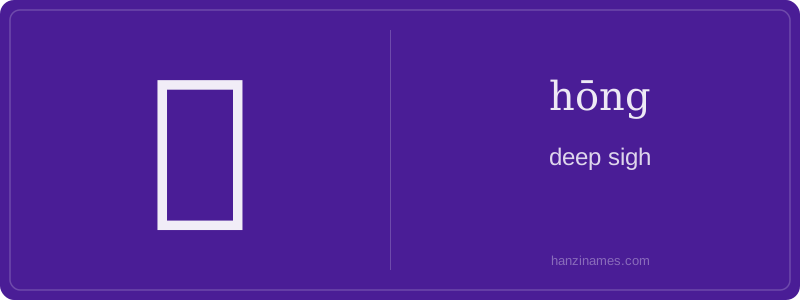
嚝 is virtually absent from classical texts, dictionaries, and standardized language exams. It does not appear in the Xiàndài Hànyǔ Cídiǎn (7th ed., 2016), the HSK word lists (Levels 1–9), or the GB2312/Unicode CJK basic block. It is a modern, internet-born orthographic coinage—used almost exclusively in informal digital contexts (e.g., Weibo comments, Bilibili subtitles, web novels) to mimic vocalized sighing. No idioms or fixed phrases contain it; it has no documented historical usage prior to ~2010.
The character is a phonosemantic compound: mouth radical (口) + 轟 (hōng, 'to boom; thunder'), borrowing the latter’s pronunciation and auditory connotation. Though 轟 itself is a pictograph of three chariots (轟 = 車×3), 嚝 repurposes it purely for its booming, resonant sound—making it a deliberate, contemporary orthographic invention rather than an ancient glyph.
The character 嚝 (hōng) is an onomatopoeic and expressive interjection used in Chinese to represent a deep, resonant sigh—often conveying weariness, exasperation, or emotional release. Unlike standard verbs like 叹 (tàn, 'to sigh') or 唉 (āi, 'alas'), 嚝 is highly colloquial and dramatic, functioning more like a vocalized sound effect than a lexical verb. It appears primarily in informal writing—especially online forums, comic dialogues, and social media—to intensify emotional tone with visceral immediacy.
While 'sigh' in English often implies quiet resignation, 嚝 carries sonic weight: it evokes a low, guttural, almost explosive expulsion of breath—akin to 'HOOOONG!' in English transliteration. This makes it functionally closer to theatrical or literary devices (e.g., Shakespearean 'Hark!' or manga sound effects like 'GROAN') than to neutral descriptive verbs. Its usage is performative, signaling not just emotion but the *audibility* and physicality of that emotion.
In cross-cultural comparison, 嚝 resembles Western interjections like 'Ugh!', 'Phew!', or 'Hmph!'—but with greater phonetic specificity and tonal gravity. Unlike English’s context-dependent 'sigh', 嚝 is rarely used alone as a verb ('he sighed'); instead, it stands as a quoted utterance ('He went: "嚝!"'). This reflects a broader Chinese linguistic tendency to encode emotion through vivid, syllable-heavy sound symbols rather than grammatical inflection—similar to how Japanese uses やれやれ (yare yare) or Korean 어허 (eo-heo) for weary resignation.
Example Sentences
Common Compounds
Similar Characters — Don't Mix These Up
Your First Step into Chinese Culture: Get a Chinese Name
Every journey into Chinese begins with a name. Use our free Chinese name generator to create a meaningful, personalized Chinese name that fits you perfectly.
Get My Chinese Name →