嚵
Character Story & Explanation
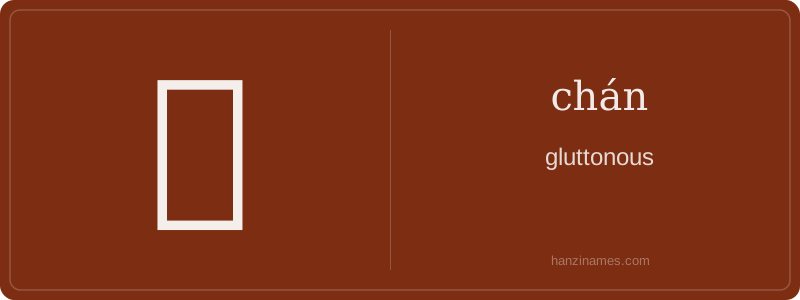
嚵 is virtually absent from modern spoken Mandarin and standard HSK curricula. It appears almost exclusively in classical literature, historical commentaries, and pre-20th-century texts — for example, in the Guangyun (1008 CE) rhyme dictionary and the Kangxi Dictionary (1716), where it is defined as 'excessively fond of food' (貪食). No idioms or fixed phrases containing 嚵 survive in contemporary usage; it has been fully supplanted by 馋 in all practical contexts.
The character is a phono-semantic compound: 口 (kǒu, 'mouth') radical + 毚 (chán, phonetic component, itself derived from 羊 'sheep' + 兔 'rabbit'). Its structure reflects its semantic domain (oral consumption) and phonetic origin, not pictographic imagery. Today, Chinese speakers encounter 嚵 only in academic or paleographic settings — if at all.
The Chinese character 嚵 (chán) is a relatively rare and literary term meaning 'gluttonous' or 'greedy in eating.' Unlike common words like 馋 (chán, 'to crave food'), 嚵 carries a stronger, more archaic moral judgment — evoking excess, lack of restraint, and even moral failing. It appears primarily in classical texts, historical critiques, and formal registers rather than everyday speech.
Its dual pronunciation (chán/chàn) reflects historical tonal shifts and variant readings preserved in dictionaries like the Kangxi Dictionary, though chán is overwhelmingly dominant in modern usage. The character’s rarity means learners rarely encounter it outside advanced reading or philological study — making it more a marker of textual literacy than conversational fluency.
In contrast to Western concepts like 'gluttony' — one of the Seven Deadly Sins rooted in Christian theology — 嚵 emphasizes behavioral excess *within a Confucian framework*, where moderation (中庸, zhōngyōng) is a core virtue. Thus, 嚵 isn’t just about overeating; it signals a failure of self-cultivation and social propriety, resonating more with ancient Greek *hybris* (excessive pride) than simple appetite.
Example Sentences
Common Compounds
Similar Characters — Don't Mix These Up
Your First Step into Chinese Culture: Get a Chinese Name
Every journey into Chinese begins with a name. Use our free Chinese name generator to create a meaningful, personalized Chinese name that fits you perfectly.
Get My Chinese Name →