嗫
Character Story & Explanation
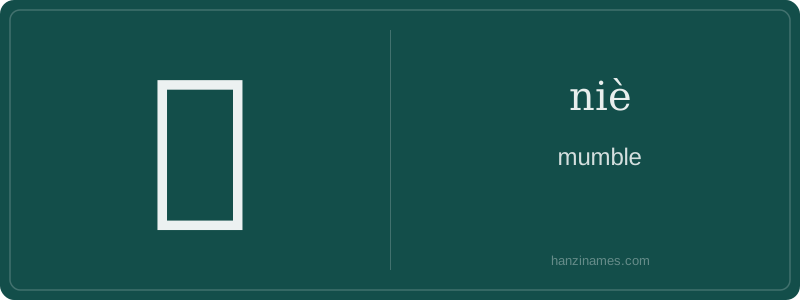
嗫 is almost always used in the fixed compound 嗫嚅 (niè rú), which appears frequently in modern Chinese literature, journalism, and formal writing to describe hesitant, incoherent, or embarrassed speech — e.g., a suspect stammering during interrogation or a student fumbling an answer. It’s documented in classical texts like the Book of Rites (Lǐjì) and appears in early 20th-century works by Lu Xun and Ba Jin to convey psychological realism and social restraint.
The character is not pictographic or ancient in origin; it’s a later phono-semantic compound. Its left side 口 clearly marks it as speech-related, while the right side 葉 (yè, 'leaf') serves only as a sound hint — its shape evolved from older forms but carries no botanical meaning here. In daily life, native speakers encounter 嗫 almost exclusively in written form, especially in novels or news reports describing emotional hesitation.
Hi students! Today we’re learning 嗫 (niè), a character that captures a very subtle, human action — moving your mouth quietly, without clear speech. It’s not about loud talking or shouting; it’s about hesitant, whispered, or suppressed speech — like when you’re nervous, ashamed, or trying not to be heard. The ‘mouth’ radical 口 tells us this is speech-related, and the right side 葉 (leaf) is a phonetic component that helps with pronunciation — though it doesn’t mean ‘leaf’ here.
This character appears almost exclusively in compound words, never alone. You’ll rarely see it in isolation — it’s too nuanced for casual use. Instead, it shows up in literary or descriptive contexts, especially when portraying inner tension: someone wanting to speak but holding back, mumbling under their breath, or speaking so softly others can barely hear.
Don’t confuse 嗫 with common verbs like 说 (shuō, 'to speak') or 讲 (jiǎng, 'to explain'). 嗫 is quieter, more psychological — it’s about the physical motion of lips and tongue *before* full articulation. Think of it as the ‘pre-speech’ gesture: lips trembling, breath catching, syllables forming but not quite released. That’s why it pairs so often with words like 嚅 (rú) — together they form 嗫嚅 (niè rú), meaning 'to mumble nervously'.
Example Sentences
Common Compounds
Similar Characters — Don't Mix These Up
Your First Step into Chinese Culture: Get a Chinese Name
Every journey into Chinese begins with a name. Use our free Chinese name generator to create a meaningful, personalized Chinese name that fits you perfectly.
Get My Chinese Name →