呓
Character Story & Explanation
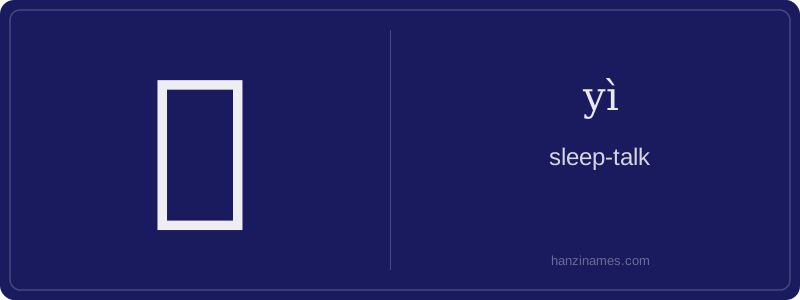
In modern Chinese, 呓 appears almost exclusively in the compound 呓语 (yìyǔ), meaning 'sleep-talking' or 'nonsensical muttering'. It’s rarely used alone—no native speaker says *‘He 呓s’*; instead, it’s always embedded: ‘说呓语’, ‘呓语连连’. Clinically, it’s referenced in TCM diagnostics and sleep medicine literature; in literature, it evokes vulnerability or subconscious truth—e.g., in Lu Xun’s essays, ‘呓语’ metaphorically describes delusional political rhetoric.
The character has no verified ancient pictographic origin. Its earliest attested form appears in the Kangxi Dictionary (1716), classified under 口, with 意 as phonetic component. Today, Chinese people encounter it most often in health apps (e.g., ‘监测是否说呓语’) or parenting guides warning about childhood night terrors—always paired, never solo.
Our detective begins at the crime scene: the character 呓. At first glance, it’s a simple 7-stroke glyph—radical 口 (mouth) on the left, 意 (intention, thought) on the right. But why combine ‘mouth’ with ‘thought’? The clue lies in physiology: sleep-talking isn’t conscious speech—it’s involuntary utterance arising from subconscious mental activity. The right side 意 doesn’t mean ‘intention’ here in its volitional sense, but rather the *unfiltered flow of inner consciousness*—a mind adrift in REM, leaking words through the mouth.
Zooming in on historical records, 呓 appears consistently in medical and literary texts from the Song dynasty onward—not in oracle bones or bronze inscriptions (it’s too late for that), but in pulse diagnosis manuals and dream-interpretation treatises. Physicians like Zhu Zhenheng noted ‘yì yǔ’ (呓语) as a diagnostic sign of heart-fire excess or phlegm misting the orifices. No mystical origin story—just centuries of clinical observation linking disordered speech during sleep to internal imbalance.
Forensic linguistics confirms the phonetic role of 意: though pronounced yì, it serves as a *sound hint*, not a semantic one—like many characters in the ‘yì’ sound family (e.g., 翼 yì ‘wing’, 屹 yì ‘towering’). This is no pictograph; it’s a phono-semantic compound forged in the Tang–Song scholarly milieu, where precision in describing pathological states demanded new lexical tools. 呓 wasn’t born of myth—it was drafted into service by doctors and poets needing to name a very real, very quiet human phenomenon.
Example Sentences
Common Compounds
Similar Characters — Don't Mix These Up
Your First Step into Chinese Culture: Get a Chinese Name
Every journey into Chinese begins with a name. Use our free Chinese name generator to create a meaningful, personalized Chinese name that fits you perfectly.
Get My Chinese Name →