囗
Character Story & Explanation
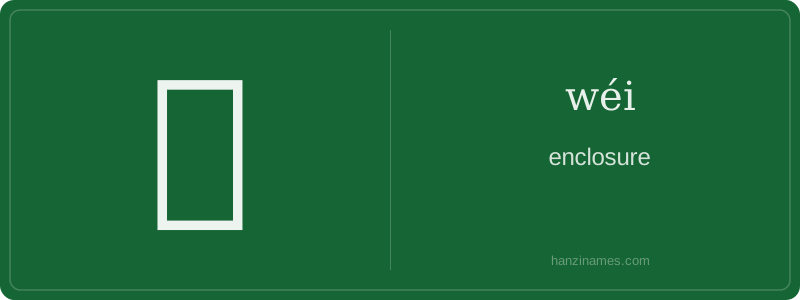
囗 is rarely used independently in modern Mandarin—it does not appear in the HSK vocabulary lists or contemporary dictionaries as a standalone word. Instead, it functions exclusively as a radical (Kangxi radical #31) in over 120+ characters related to boundaries, territory, or containment. You’ll find it in high-frequency words like 国 (country), 团 (group), and 围 (to surround). Historically, 囗 appears in early seal script (c. 3rd century BCE) as a stylized representation of an enclosed area—likely derived from pictographic depictions of walls or barriers, though no oracle bone form survives.
The earliest verified form is in Warring States bronze inscriptions, where it consistently denotes bounded space. Today, Chinese learners encounter it first when studying stroke order and radical classification—not pronunciation. Its enduring role is structural, not lexical.
Hello, learners! Today we’ll explore 囗 (wéi), a foundational character that looks like a simple square—but don’t be fooled! It’s not a standalone word you’d use in conversation. Instead, 囗 is one of the most important *radicals* in Chinese—specifically, the 'enclosure radical'. It appears as a frame around other characters to signal containment, boundary, or spatial enclosure. Think of it like a visual fence: when you see 囗 wrapping another component (e.g., 在, 圆, 国), it hints that the meaning involves being inside, surrounded, or defined by limits.
This radical is essential for recognizing and understanding dozens of common characters. Though it’s written with just three strokes (vertical → horizontal → vertical), its shape has remained remarkably stable for over two millennia—from bronze inscriptions to modern fonts. Its simplicity belies its structural power: it’s among the top 10 most frequent radicals in printed Chinese and appears in over 120 standard characters listed in the Kangxi Dictionary.
As a beginner, focus on recognizing 囗—not pronouncing it alone. You won’t say ‘wéi’ by itself in daily speech, but you *will* see it constantly: in 国 (guó, country), 园 (yuán, garden), and 困 (kùn, trapped). Mastering this radical helps you decode meaning and improve reading fluency. It’s like learning the ‘-ed’ suffix in English: rarely spoken alone, but vital for understanding grammar and vocabulary.
Example Sentences
Common Compounds
Similar Characters — Don't Mix These Up
Your First Step into Chinese Culture: Get a Chinese Name
Every journey into Chinese begins with a name. Use our free Chinese name generator to create a meaningful, personalized Chinese name that fits you perfectly.
Get My Chinese Name →