囱
Character Story & Explanation
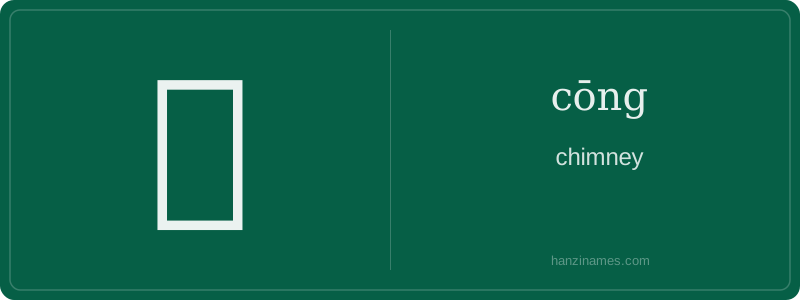
In contemporary China, 囱 appears primarily in technical contexts: building inspection reports, fire department regulations, and classical architecture textbooks. While ordinary speakers say 烟囱 (yāncōng) — literally 'smoke chimney' — 囱 alone is reserved for formal writing, such as municipal heating infrastructure plans or UNESCO documentation for historic Hutong renovations in Beijing. It’s absent from HSK lists due to low frequency, but appears in the Chinese Dictionary of Building Terms (2018, China Architecture & Building Press).
This character is a documented pictograph: oracle bone and bronze inscriptions are scarce, but seal script forms (c. 3rd century BCE) clearly show a square enclosure (囗) with a vertical line inside — representing a roof opening aligned over a stove. No disputed origin exists; scholars (e.g., Li Xueqin, Early Chinese Writing, 2000) confirm its direct derivation from chimney morphology.
The character 囱 (cōng) is a vivid pictographic relic — its shape mirrors a traditional Chinese brick chimney rising from a tiled roof, enclosed by the 'enclosure' radical 囗 (wéi), symbolizing containment or boundary. Though simple in stroke count (7), it captures architectural function: venting smoke upward. Unlike many modern characters, 囱 retains strong visual logic, making it memorable for learners who connect form to function.
Historically, 囱 appeared in early printed texts and Qing-dynasty building manuals, always denoting the vertical flue of heated kang beds or kitchen stoves. It never evolved into abstract usage like many radicals; instead, it stayed narrowly technical — a testament to how Chinese writing preserves functional vocabulary across centuries without semantic drift.
Today, 囱 is rare in daily speech (replaced colloquially by 烟囱 yāncōng), but remains essential in architectural drafting, fire-safety codes, and heritage restoration documents. Its survival reflects China’s layered urban development: from Ming-era courtyard homes with single-flue chimneys to today’s high-rises where 囱 appears only in historical schematics or safety compliance reports.
Example Sentences
Common Compounds
Similar Characters — Don't Mix These Up
Your First Step into Chinese Culture: Get a Chinese Name
Every journey into Chinese begins with a name. Use our free Chinese name generator to create a meaningful, personalized Chinese name that fits you perfectly.
Get My Chinese Name →