囿
Character Story & Explanation
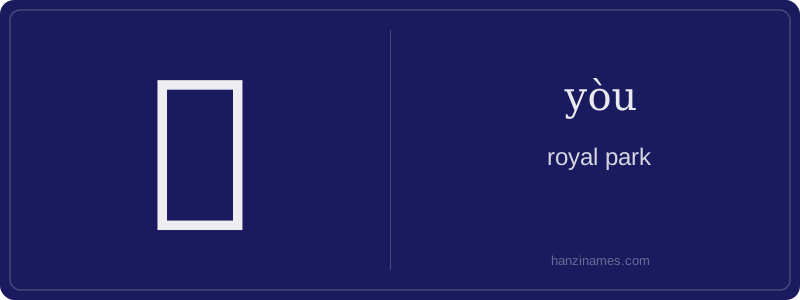
Today, 囿 appears almost exclusively in historical, literary, or academic contexts—not daily conversation. It survives in classical compounds like 灵囿 (língyòu, 'sacred park') from the Book of Songs, and in modern scholarly writing on ancient Chinese land use. You’ll encounter it in museum labels (e.g., 'Zhou Dynasty Royal You') or historical novels—but never on a city park sign; for that, people use 公园 (gōngyuán). Its usage is highly specialized and archaic.
The character is a clear phono-semantic compound: the outer 囗 (enclosure radical) visually represents a walled perimeter, while the inner 有 ('to have') provides sound (yǒu → yòu via tone shift) and semantic nuance—'a place one possesses.' This structure is well-documented in Shuōwén Jiězì (121 CE), China’s earliest dictionary, confirming its origin as a bounded, owned space—not a pictograph of trees or animals.
As an archaeologist brushing dust from a Western Zhou bronze inscription, I found 囿 etched beside pictorial depictions of walled enclosures holding deer and pheasants—evidence that this character originated not as a generic 'park,' but as a royal hunting reserve. Its enclosure radical 囗 (wéi) frames the phonetic component 有 (yǒu), signaling both containment and possession: land held exclusively by nobility for ritualized sport and symbolic dominion over nature.
Excavations at Qufu and Luoyang reveal that 囿 were meticulously documented in early texts like the Rites of Zhou, where their size, species inventory, and seasonal access rules were codified. Unlike later ornamental gardens, these spaces functioned as geopolitical tools—buffer zones, ecological reserves, and venues for diplomatic hunts. The character’s nine strokes encode hierarchy: the outer wall (囗) is drawn first, asserting control before any life (有) is admitted within.
This character resists modern simplification—it remains unchanged from seal script to standard楷书—suggesting its conceptual weight endured across dynasties. Even when Confucius criticized rulers who ‘neglected the people but expanded their 囿,’ the term retained its specificity: not mere green space, but a sovereign’s curated, bounded domain where nature was managed, not merely admired. Its rarity today reflects not obsolescence, but semantic precision preserved.
Example Sentences
Common Compounds
Similar Characters — Don't Mix These Up
Your First Step into Chinese Culture: Get a Chinese Name
Every journey into Chinese begins with a name. Use our free Chinese name generator to create a meaningful, personalized Chinese name that fits you perfectly.
Get My Chinese Name →