圃
Character Story & Explanation
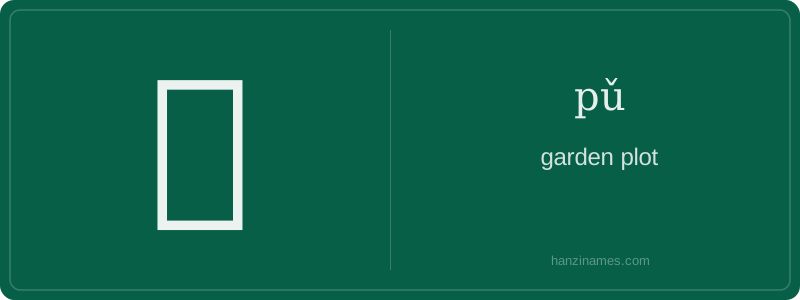
Today, 圃 appears primarily in formal, institutional, or literary contexts—not in casual speech. It survives in compound words like 苗圃 (miáopǔ, 'nursery') and 花圃 (huāpǔ, 'flower bed'), commonly seen on botanical garden signage, agricultural extension materials, and urban planning documents. Historically, it appears in Tang and Song dynasty texts describing imperial horticultural bureaus and monastic medicinal gardens—e.g., the 11th-century *Yingzao Fashi* (Treatise on Architectural Methods) references ‘藥圃’ (yàopǔ, ‘herb garden’) in monastery layouts.
The character’s form is not pictographic but phono-semantic: 囗 (wéi, ‘enclosure’) as semantic radical signals bounded space; 甫 (fǔ) as phonetic component gives the sound. No oracle-bone or bronze inscription of 圃 exists—it first appears in standardized Qin seal script, confirming its origin as a deliberate administrative term for regulated cultivation plots.
As an archaeologist brushing dust from a Han dynasty bamboo slip, I find 圃 inscribed not as a mere word—but as a bounded space of cultivation. The outer 囗 (wéi) radical—a closed square—evokes ancient walled enclosures: not fortresses, but protected plots where herbs, peonies, or medicinal roots were tended with ritual care. This wasn’t wilderness; it was intentional, human-shaped earth—a microcosm of harmony between order and growth.
Peeling back layers, I note how 圃 diverges from broader terms like 園 (yuán, 'garden') or 庭 (tíng, 'courtyard'). Its ten strokes encode specificity: the inner ‘甫’ (fǔ) component—originally a phonetic marker—later acquired semantic resonance, linking to concepts of ‘beginning’ and ‘foundation’. Thus, 圃 implies a garden at its genesis: freshly prepared, purposefully delimited, awaiting sowing.
Unlike pictographic characters etched in oracle bone, 圃 emerged fully formed in early seal script (c. 3rd century BCE), reflecting bureaucratic precision: land registers, imperial horticultural edicts, and agricultural treatises all used 圃 to denote officially designated cultivation zones. Its stability across 2,200 years testifies less to poetic metaphor and more to administrative continuity—the quiet persistence of measured, managed green space in Chinese civilization.
Example Sentences
Common Compounds
Similar Characters — Don't Mix These Up
Your First Step into Chinese Culture: Get a Chinese Name
Every journey into Chinese begins with a name. Use our free Chinese name generator to create a meaningful, personalized Chinese name that fits you perfectly.
Get My Chinese Name →