圜
Character Story & Explanation
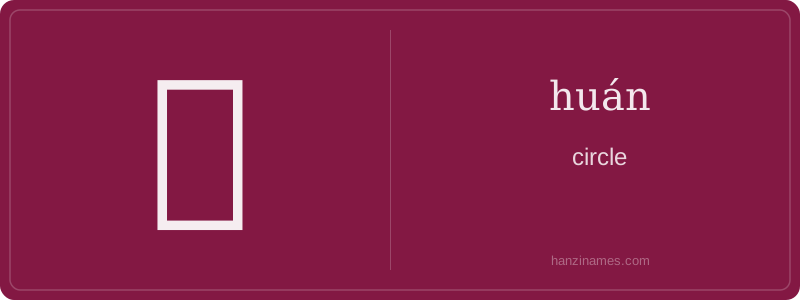
In daily life, 圜 is rarely used independently but appears in historical and institutional names: the Temple of Heaven’s 圜丘坛 (Huánqiū Tán, Circular Mound Altar) is a UNESCO-recognized site where emperors worshipped heaven annually. It also survives in financial jargon — 圜 was an archaic term for 'coin' or 'currency' (e.g., in classical texts like the *Book of Han*), giving rise to the modern word 银行 (yínháng, 'bank'), literally 'silver circulation'. The idiom 圜流不息 (huánliú bùxī, 'circulation without cease') echoes this monetary sense.
The character’s form is not a pictograph but a phono-semantic compound: the outer 囗 radical signifies enclosure; the inner part (睘) serves as a phonetic component (historically approximating yuán/huán). No oracle bone or bronze script forms survive — it first appears reliably in Warring States bamboo texts, already in its mature structure.
圜 (huán) is a classical Chinese character meaning 'circle' or 'circular enclosure', evoking harmony, completeness, and cyclical continuity. Though rare in modern spoken Mandarin, it survives in literary, historical, and formal contexts — especially in compound words related to astronomy, finance, or ritual space. Its radical 囗 (wéi), meaning 'enclosure', visually reinforces the idea of bounded circularity, much like a city wall or celestial orbit.
The character’s dual pronunciation reflects its layered usage: huán emphasizes motion or circulation (e.g., circulating funds), while yuán — homophonous with 圆 (yuán, 'round') — highlights shape and wholeness. This phonetic overlap isn’t accidental: in ancient texts like the *Rites of Zhou*, 圜 specifically denoted the circular altar used for heaven worship, distinguishing it from square altars for earth — a cosmological duality deeply embedded in imperial ritual architecture.
Today, 圜 appears most often in fixed terms like 圜丘 (huánqiū, 'Circular Mound Altar') — the iconic open-air坛 at Beijing’s Temple of Heaven, where Ming and Qing emperors performed winter solstice sacrifices. Its presence there reminds us that while everyday speech favors 圆, 圜 preserves a precise, ceremonial register — one where form, function, and philosophy converge in a single, elegant circle.
Example Sentences
Common Compounds
Similar Characters — Don't Mix These Up
Your First Step into Chinese Culture: Get a Chinese Name
Every journey into Chinese begins with a name. Use our free Chinese name generator to create a meaningful, personalized Chinese name that fits you perfectly.
Get My Chinese Name →