圳
Character Story & Explanation
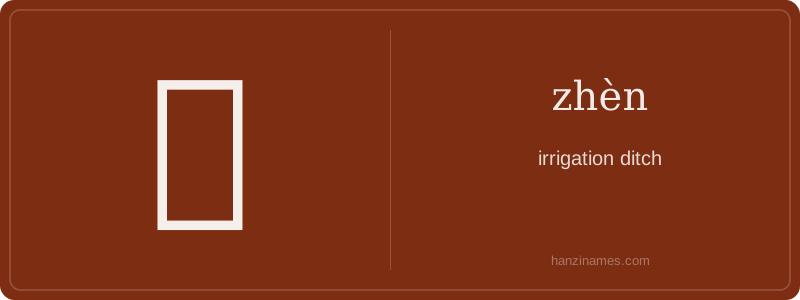
The character 圳 appears almost exclusively in place names across Guangdong and Fujian, most famously in 深圳 (Shēnzhèn), now a global metropolis but historically a collection of fishing villages and rice-growing hamlets linked by irrigation ditches. It survives in over 200 documented village names in Guangdong alone, per the 2010 Guangdong Provincial Gazetteer. No common idioms or literary phrases feature 圳—it’s geographically bound, not figuratively extended.
The character’s form is not pictographic in origin (no oracle bone or bronze script attestation exists). Instead, it’s a later phono-semantic compound: 土 (earth, semantic) + 川 (chuān, phonetic, approximating zhèn in Middle Chinese). Today, Chinese people encounter 圳 almost solely in the city name 深圳—and rarely pause to consider its agrarian meaning, though municipal signage sometimes highlights this heritage in cultural exhibitions.
As an archaeologist sifting through layers of Guangdong’s Lingnan soil, I found 圳 not carved on oracle bones—but etched into centuries of agrarian life. Its six strokes—earth (土) anchored beneath a phonetic component (川, chuān, meaning 'river')—reveal a practical innovation: a human-made channel guiding water between rice paddies. This wasn’t ceremonial script; it was fieldwork inscribed, a functional glyph born from hydraulic necessity in low-lying, monsoon-soaked terrain.
The radical 土 confirms its grounding in land management—no abstract ideation here. Unlike characters evoking cosmic order, 圳 emerged from the mud: farmers digging, draining, and dividing fields. Its phonetic hint 川 subtly echoes flowing water, yet the character itself never meant ‘river’—only the controlled, linear trench *between* fields. This precision reflects ancient Southern Chinese hydrological literacy, long before modern surveying tools.
Modern excavations of Song–Ming irrigation maps from Shenzhen’s Dapeng Peninsula confirm 圳 as a toponymic anchor—villages named after specific ditches (e.g., Baishizhen, ‘White Stone Ditch’). Even today, local elders point to earthen furrows still bearing the name 圳, their banks worn smooth by 800 years of runoff. This character is less a relic than a living artifact: silent, functional, and deeply rooted—not in myth, but in mud, measurement, and memory.
Example Sentences
Common Compounds
Similar Characters — Don't Mix These Up
Your First Step into Chinese Culture: Get a Chinese Name
Every journey into Chinese begins with a name. Use our free Chinese name generator to create a meaningful, personalized Chinese name that fits you perfectly.
Get My Chinese Name →