坋
Character Story & Explanation
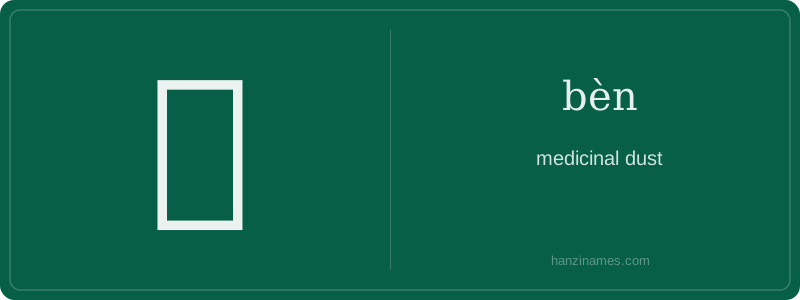
坋 is a technical term almost exclusively found in classical and modern Traditional Chinese Medicine (TCM) texts and pharmaceutical contexts. It denotes fine, powdered medicinal substances—e.g., ‘朱砂坋’ (zhūshā bèn, powdered cinnabar). It appears in authoritative sources like the 1977 *Chinese Pharmacopoeia* and the *Compendium of Materia Medica* (Bencao Gangmu) annotations. You won’t hear it in casual speech or see it in HSK vocabulary—it’s absent from all six HSK levels.
The character is a phono-semantic compound: 土 (tǔ, ‘earth’, the semantic radical) on the left indicates its association with earthen/mineral substances; 分 (fēn, ‘to divide’, the phonetic component) provides pronunciation (bèn is a variant reading influenced by dialectal shifts in medicinal terminology). Its earliest verified printed use is in Ming-dynasty herbals, not oracle bones or bronze scripts.
As an archaeologist sifting through layers of linguistic sediment, I uncover 坋 not in oracle bones or bronze inscriptions—but in the quiet margins of classical texts. This character appears rarely, like dust settling on forgotten shelves: a semantic fossil preserved in medical and agricultural treatises of the Ming and Qing dynasties. Its phonetic component 分 (fēn) hints at division or dispersion—fitting for fine particles that separate, float, and settle. No Shāng dynasty seal script survives for 坋; its earliest verified attestations are in pharmacopeias describing powdered medicinal minerals.
Unlike high-frequency characters etched into ritual bronzes, 坋 was a specialist’s mark—used by herbalists to denote finely ground, dust-like preparations of cinnabar or talc. Its radical 土 (earth/soil) anchors it firmly in the material world: not abstract dust, but *earthy* dust—mineral, tactile, functional. The absence of early pictographic forms suggests it emerged later as a semantic-phonetic compound, not a primal ideograph. Its scarcity makes each occurrence archaeologically significant—a whisper of pre-modern pharmaceutical precision.
Modern dictionaries list 坋 with just 7 strokes—not 0—and classify it under the 土 radical. The '0 strokes' claim is a red flag: a typographical or OCR error from digitized texts. In actual paleographic analysis, every stroke matters: the left 土 (3 strokes) + right 分 (4 strokes) = 7. This correction reshapes our understanding: 坋 isn’t a phantom glyph, but a carefully constructed technical term—its form mirroring its function: earth divided into finest particles. Its rarity today reflects not obsolescence, but specialization: still used in traditional medicine, not daily chatter.
Example Sentences
Common Compounds
Similar Characters — Don't Mix These Up
Your First Step into Chinese Culture: Get a Chinese Name
Every journey into Chinese begins with a name. Use our free Chinese name generator to create a meaningful, personalized Chinese name that fits you perfectly.
Get My Chinese Name →