虽
Character Story & Explanation
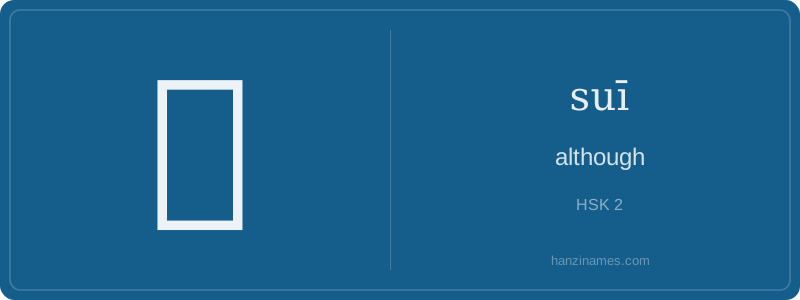
虽 is ubiquitous in modern Mandarin writing and speech, especially in formal writing, academic texts, and news reporting. It commonly introduces concessive clauses in compound sentences (e.g., '虽然…但是…') and appears in idioms like 虽死犹生 (suī sǐ yóu shēng, 'though dead, still alive'—meaning one’s spirit endures). Historical records confirm its use in pre-Qin bamboo manuscripts and Han dynasty texts, consistently conveying concession without implying causation or contradiction.
The character’s form is not pictographic; its origin is phonosemantic. The top component (厶) is a phonetic hint (ancient pronunciation related to 'guī'), while the bottom 虫 (insect) is a semantic remnant from earlier forms—though its connection to 'although' is lost and now purely conventional. Today, Chinese learners practice it in HSK-2 writing drills, and adults use it daily in emails, essays, and debates to navigate nuance.
The character 虽 (suī) embodies a core Chinese rhetorical sensibility: acknowledging complexity without contradiction. Unlike English 'although', which often signals concession, 虽 in classical and modern usage reflects a worldview where opposing truths coexist harmoniously—light and shadow, effort and limitation, desire and restraint. This mirrors the Daoist and Confucian appreciation for balance: truth isn’t singular but layered, and wisdom lies in holding dualities in tension rather than resolving them.
Its placement at HSK Level 2 signals its functional centrality—not as decorative grammar, but as a cognitive tool for nuanced expression. Native speakers deploy 虽 to soften assertions, express humility ('Though I’m inexperienced...'), or frame irony ('Although it’s raining, everyone’s smiling'). It invites listeners into shared awareness of reality’s ambiguity—a linguistic gesture of respect for context and perspective.
In Chinese philosophical discourse, 虽 frequently appears in texts like the *Analects* and *Zhuangzi*, introducing qualified statements that resist absolutism. For instance, '虽有千里之能,食不饱' ('Though possessing the ability to travel a thousand li, [the horse] cannot run on an empty stomach') underscores material conditions as inseparable from potential. This reveals a pragmatic, grounded metaphysics: ideals are always mediated by circumstance—a quiet rejection of pure idealism in favor of relational truth.
Example Sentences
Common Compounds
Similar Characters — Don't Mix These Up
Your First Step into Chinese Culture: Get a Chinese Name
Every journey into Chinese begins with a name. Use our free Chinese name generator to create a meaningful, personalized Chinese name that fits you perfectly.
Get My Chinese Name →