坤
Character Story & Explanation
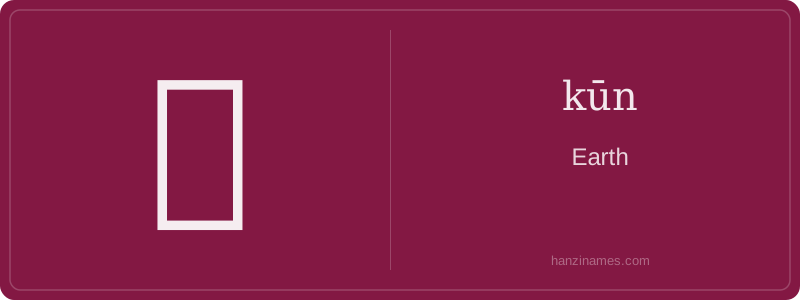
坤 is rarely used alone in modern daily speech but appears in formal, literary, and philosophical contexts: in classical poetry, Daoist texts, and compound terms like 坤卦 (kūn guà, 'Kun trigram') or 坤德 (kūn dé, 'virtue of receptivity'). It features in historical imperial titles—e.g., Empress Dowager Cixi was sometimes referred to using 坤元 (kūn yuán, 'Earth’s origin') to evoke her maternal, stabilizing authority. The term 坤士 (kūn shì, 'female scholar') appears in Ming-Qing era writings, distinguishing educated women.
The character is not pictographic; its earliest attested form (bronze script, c. 11th–3rd BCE) shows 土 (earth radical) with phonetic component 申 (shēn), later simplified. No oracle bone form survives. Today, Chinese people encounter 坤 most commonly in names (e.g., actor Wu Jing’s son is named Wu Kun), in feng shui consultations, or when studying the Yijing—not as slang, but as a marker of cultural literacy and cosmological awareness.
坤 (kūn) is the second of the Eight Trigrams (八卦) in Chinese cosmology and philosophy, representing Earth, receptivity, femininity, and nurturing energy. Unlike the active, creative force of 乾 (qián), 坤 embodies yielding strength—like fertile soil that receives and transforms seeds into life. It appears in foundational texts like the Yijing (I Ching), where it symbolizes the passive yet essential counterpart to Heaven, forming the cosmic duality of yin and yang.
In traditional Chinese thought, 坤 is not weakness but profound capacity—the ability to hold, sustain, and support. Its association with Earth links it to geography (e.g., southern regions in trigram mapping), seasons (late summer), and ethics (modesty, humility, endurance). This conceptual richness makes 坤 central to feng shui, Daoist practice, and classical governance metaphors, where rulers were urged to emulate 坤’s inclusive, grounded virtue.
Western equivalents include Gaia (Greek Earth goddess), Terra Mater (Roman Earth mother), or the alchemical element ‘Earth’—but these emphasize physical substance or deity worship, whereas 坤 is a dynamic *principle*: relational, process-oriented, and inseparable from Heaven (乾). Unlike Western dualisms that often privilege spirit over matter, 坤’s earthiness is sacred, intelligent, and generative—reflecting a holistic worldview where nature is neither inert nor subordinate, but co-creative and sovereign in its own right.
Example Sentences
Common Compounds
Similar Characters — Don't Mix These Up
Your First Step into Chinese Culture: Get a Chinese Name
Every journey into Chinese begins with a name. Use our free Chinese name generator to create a meaningful, personalized Chinese name that fits you perfectly.
Get My Chinese Name →