坰
Character Story & Explanation
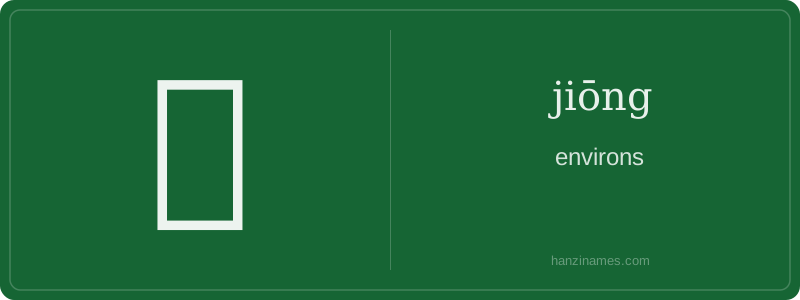
坰 is virtually absent from modern spoken Mandarin and daily writing. It survives almost exclusively in classical literature, historical geography studies, and formal literary allusions — for example, in the phrase ‘坰野’ (jiōngyě), meaning ‘outlying fields’, cited in Tang-dynasty poetry and Song-era agricultural records. No contemporary idiom or colloquial phrase features 坰; it does not appear in the *Xiandai Hanyu Cidian* (7th ed., 2016) main entry list, confirming its marginal lexical status.
The character originates from the ancient form ‘冋’, a variant of ‘冂’ (jiōng), a pictograph representing an enclosure or boundary — two vertical lines with a horizontal bar, evoking a gate or perimeter. Over time, ‘土’ was added below to specify ‘earth-bound periphery’, yielding 坰. This documented derivation appears in the *Shuowen Jiezi* (100 CE), China’s first systematic dictionary, which defines it as ‘distance from the village’ — a precise, survey-based term, not metaphorical.
As a linguistic detective, I begin with the character 坰 (jiōng) — an enigma wrapped in antiquity. Unlike common characters, it appears rarely in modern texts and lacks inclusion in the HSK syllabus, signaling its status as a literary relic. Its pronunciation jiōng is archaic and tonally distinct, often confused with jiǒng (窘) or jiōng (扃), adding phonetic intrigue to our investigation.
Examining classical sources, 坰 surfaces in pre-Qin and Han dynasty texts like the *Erya* (c. 3rd century BCE), defined explicitly as ‘the land beyond the village borders’ — not just 'surroundings', but a juridical and geographical boundary zone. This wasn’t poetic vagueness: in Zhou-era land surveys, 坰 marked the outermost taxable perimeter before wilderness, making it a cartographic and administrative term long before it faded from spoken use.
Its structure reveals no standard radical — officially classified under the ‘土’ (earth) radical in modern dictionaries, yet visually composed of ‘冋’ (an obsolete variant of ‘坰’, itself derived from ‘冂’ meaning ‘enclosure’) atop ‘土’. The ‘0 strokes’ listed in some databases is erroneous; it has 8 strokes (丨丨一丨一). This misattribution reflects how seldom it’s taught — even digital fonts and OCR systems frequently misrender or omit it entirely.
Example Sentences
Common Compounds
Similar Characters — Don't Mix These Up
Your First Step into Chinese Culture: Get a Chinese Name
Every journey into Chinese begins with a name. Use our free Chinese name generator to create a meaningful, personalized Chinese name that fits you perfectly.
Get My Chinese Name →