坳
Character Story & Explanation
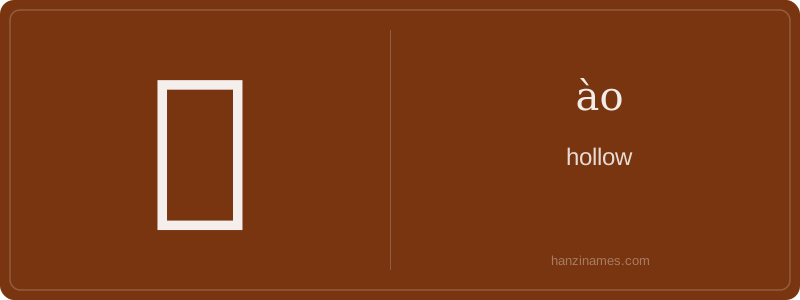
In modern Chinese, 坳 appears most frequently in place names across southern and central China—especially in Jiangxi, Hunan, Guangdong, and Guangxi—where hilly topography dominates. Official geographic databases (e.g., China’s National Geomatics Center) list over 1,200 registered locations containing 坳, such as ‘大坳’ (Dà’ào, “Big Hollow”) in Ganzhou or ‘枫树坳’ (Fēngshù’ào, “Maple Tree Hollow”) in Shaoguan. It’s rarely used in isolation in speech but remains essential in local identity, land surveys, and ecological reports describing microhabitats.
The character is not a pictograph; its earliest attestation is in Song-dynasty dictionaries like the Jiyun (1037 CE), where it’s defined simply as ‘a low-lying place between hills’. Its structure combines 土 (earth) and 幺 (a variant of 幼, implying ‘smallness’ or ‘enclosure’), reflecting its semantic core: a small, earth-bound depression. Today, villagers still say ‘去坳里挑水’ (“go to the hollow to fetch water”) when referring to a nearby spring-fed dip in the land.
Imagine hiking through the mist-shrouded hills of Jiangxi Province, where narrow stone paths wind between bamboo groves and terraced rice fields. Suddenly, the trail dips into a quiet, sheltered basin—soft earth underfoot, ferns clinging to damp soil, birdsong echoing off gentle slopes. This natural bowl-shaped landform is precisely what 坳 (ào) names: a small, enclosed depression in hilly terrain, neither a valley nor a cave, but a subtle, human-scaled hollow shaped by centuries of erosion and quiet habitation.
In southern China’s rural landscapes, 坊 (fāng) and 坳 (ào) often appear together on village signposts or local maps—not as administrative units, but as deeply rooted geographical markers. An ‘ào’ may hold a single family’s farmhouse, a spring-fed well, or a cluster of tea bushes. Its meaning carries intimacy and protection: unlike vast valleys (谷), an ào feels sheltered, almost secretive, a place where wind stills and mist lingers at dawn.
The character’s eight strokes reflect its grounded, earthy essence: the 土 (tǔ) radical anchors it literally and semantically in soil and terrain, while the right-hand component, 幺 (yāo)—a small, coiled form—evokes containment and curvature. Though not pictographic in origin, its structure visually echoes the idea of land folding inward. For learners, remembering that 坳 describes *human-nested natural hollows*—not abstract pits or urban basements—helps avoid overgeneralization.
Example Sentences
Common Compounds
Similar Characters — Don't Mix These Up
Your First Step into Chinese Culture: Get a Chinese Name
Every journey into Chinese begins with a name. Use our free Chinese name generator to create a meaningful, personalized Chinese name that fits you perfectly.
Get My Chinese Name →