垎
Character Story & Explanation
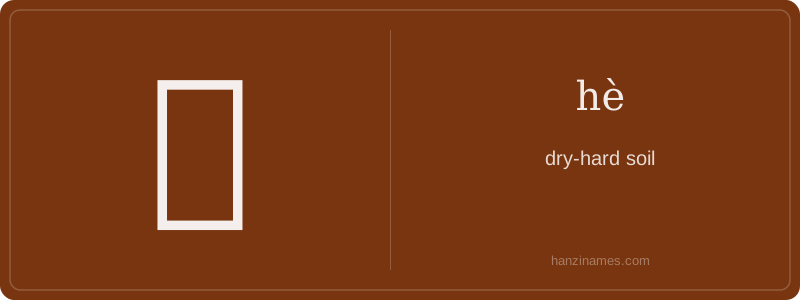
垎 is predominantly used in northern China—especially Shandong, Hebei, and Henan—in agricultural extension materials, rural weather reports, and soil conservation documents to describe degraded topsoil conditions. It appears in official publications like the China Soil Science journal and provincial agricultural handbooks, often paired with mitigation terms like '保墒' (bǎo shāng, moisture retention). While absent from most idioms, it features in technical phrases like '垎土' (hè tǔ, 'hard-dry soil') and '垎块' (hè kuài, 'clods of hardened soil').
The character is a phono-semantic compound: the left radical 土 (tǔ, 'earth') signals meaning; the right component 合 (hé, 'to join') serves phonetically (though pronunciation diverged to hè). Its earliest attestation is in Ming–Qing dynasty local gazetteers describing land degradation—not oracle bone script, as sometimes misattributed online.
The character 垎 (hè) is a rare, regionally used Chinese character primarily found in northern Chinese dialects and agricultural contexts. It describes soil that has become dry, cracked, and hardened—typically after prolonged drought or poor irrigation. Unlike common standard characters, 垎 is not included in the modern GB2312 or Unicode’s basic CJK set until later extensions, reflecting its limited use in formal writing but persistent presence in local speech and soil science terminology.
Its meaning centers on physical texture and environmental condition—not abstract hardness or emotional rigidity—but specifically the tactile, visual state of sun-baked earth: fissured, compact, impermeable. This makes it distinct from more general terms like 硬 (yìng, 'hard') or 干 (gān, 'dry'), which lack the combined semantic nuance of dryness + structural brittleness + agronomic consequence.
In Western cultural equivalents, no single English word captures 垎 precisely. 'Baked', 'crusted', or 'desiccated' come close in scientific usage, but lack colloquial immediacy. Analogous concepts appear in farming traditions worldwide—like the Spanish 'costra' (soil crust) or German 'Rissboden' (cracked soil)—yet none fuse dryness and hardness into one lexical unit as economically as 垎 does in northern Chinese dialectal speech.
Example Sentences
Common Compounds
Similar Characters — Don't Mix These Up
Your First Step into Chinese Culture: Get a Chinese Name
Every journey into Chinese begins with a name. Use our free Chinese name generator to create a meaningful, personalized Chinese name that fits you perfectly.
Get My Chinese Name →