垗
Character Story & Explanation
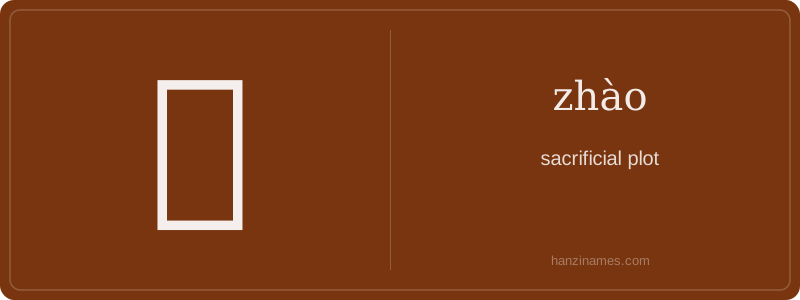
垗 (zhào) is virtually absent from modern spoken or written Mandarin. It appears only in classical texts, archaeological reports, and scholarly discussions of ancient ritual geography. No idioms, set phrases, or contemporary compounds contain it. The *Xiandai Hanyu Cidian* (7th ed., 2016) lists it as archaic with no living usage. Its sole documented function is as a noun meaning 'sacrificial enclosure' or 'consecrated plot'—a term found in bronze inscriptions and transmitted texts like the *Zhouli* (Rites of Zhou).
The character is a phono-semantic compound: the radical 土 (tǔ, 'earth/soil') indicates its domain, while the phonetic component 召 (zhào) provides pronunciation. Unlike pictographic characters (e.g., 日 'sun'), 垗 offers no visual depiction—it emerged in the Western Zhou period as a technical term for ritually demarcated land, reflecting bureaucratic standardization of sacrificial practice.
As an archaeologist brushing dust from a fragmented bronze inscription, I first encountered 垗 (zhào) not in dictionaries—but carved beside ritual vessel inscriptions from the late Western Zhou (c. 9th century BCE). Its presence signals sacred space: not the act of offering itself, but the consecrated ground where sacrifice occurred—akin to marking hallowed soil before a fire altar. This semantic precision reveals how early Chinese cosmology spatialized ritual: holiness wasn’t abstract; it was *grounded*, literally.
The character’s rarity today reflects a linguistic narrowing: as state rites centralized and Confucian texts standardized terminology, broader terms like 祭 (jì, 'to sacrifice') eclipsed the geographically specific 垗. Yet its survival in excavated texts confirms its ancient weight—not as a verb, but as a noun denoting liminality: the threshold between human and divine realms, measured in square feet of tamped earth.
Modern lexicographers classify 垗 as obsolete in spoken Mandarin, yet its archaeological resonance persists. When we find it on bamboo slips from the Guodian cache or in the *Shuowen Jiezi* (100 CE), it anchors us to a worldview where geography and theology were inseparable. To read 垗 is to stand on the same earth where diviners interpreted cracks in oracle bones—and where every grain of soil held covenantal meaning.
Example Sentences
Common Compounds
Similar Characters — Don't Mix These Up
Your First Step into Chinese Culture: Get a Chinese Name
Every journey into Chinese begins with a name. Use our free Chinese name generator to create a meaningful, personalized Chinese name that fits you perfectly.
Get My Chinese Name →