垚
Character Story & Explanation
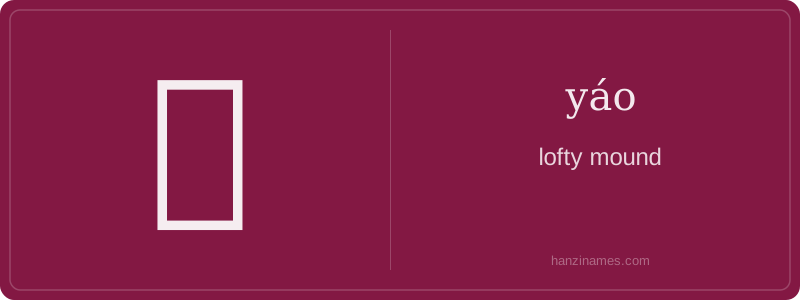
垚 is almost exclusively used in personal names — especially given names — across China, Taiwan, and overseas Chinese communities. It’s prized for its auspicious connotations of stability, groundedness, and lofty virtue. You’ll find it in names like Wang Yao (王垚) or Li Yao (李垚), often chosen by parents hoping their child will be 'as solid and elevated as layered earth'. It does not appear in standard HSK vocabulary, modern idioms, or common compounds.
The character’s form is not pictographic but ideographic: it’s a triple repetition of 土 (tǔ, 'earth'), a known method in ancient Chinese script to intensify meaning — here, emphasizing height and massiveness. This reduplication pattern (e.g., 林 lín 'forest' = two trees; 森 sēn 'dense forest' = three trees) is well-documented in bronze inscriptions and Shuowen Jiezi (100 CE). No oracle bone form survives, but its logic is consistent with early character formation principles.
垚 (yáo) is a fascinating character that looks like three 'earth' radicals stacked together — 土 + 土 + 土. Though it’s sometimes loosely glossed as 'embankment', its core meaning is actually 'high earth' or 'lofty mound', evoking layers of soil piled up to form a raised, stable landform. It’s not a common word in daily speech, but appears in names and classical contexts where elevation and solidity matter — think of ancient city walls built from compacted earth.
This character is deeply visual: each 土 represents a layer of fertile, cultivated ground, and stacking them emphasizes height, strength, and accumulation. Unlike simple nouns like 地 (dì, 'ground') or 坡 (pō, 'slope'), 垚 carries a poetic weight — suggesting something deliberately constructed and enduring, like a sacred earthen altar or a fortified hilltop settlement in early Chinese civilization.
As a beginner, don’t worry about memorizing 垚 for everyday conversation — it’s rare in modern texts. But recognizing it helps you appreciate how Chinese characters build meaning through repetition and spatial arrangement. Its 9-stroke structure follows clear rules: write each 土 left-to-right, top-to-bottom, with the horizontal stroke always first in each component. Practice slowly — consistency matters more than speed!
Example Sentences
Common Compounds
Similar Characters — Don't Mix These Up
Your First Step into Chinese Culture: Get a Chinese Name
Every journey into Chinese begins with a name. Use our free Chinese name generator to create a meaningful, personalized Chinese name that fits you perfectly.
Get My Chinese Name →