垣
Character Story & Explanation
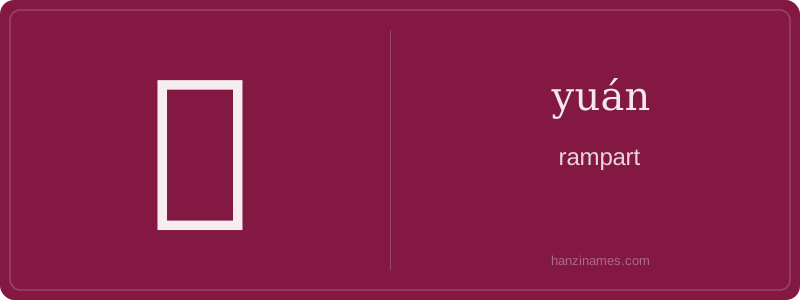
垣 appears in classical texts like the Book of Rites (Lǐjì) describing courtyard enclosures for ancestral rites, and remains embedded in real place names across China—e.g., Yùnyáng Yuán (云阳垣) in Shaanxi, referencing ancient rammed-earth fortifications. It features in the idiom 断壁残垣 (duàn bì cán yuán), meaning 'broken walls and ruined ramparts', widely used in literature and media to evoke war-torn desolation or historical decay.
The character is a phono-semantic compound: 土 (tǔ, 'earth') as semantic radical indicates material; 袁 (yuán) as phonetic component provides pronunciation. Archaeologically, it reflects early Chinese rammed-earth construction (hangtu), documented at Shang dynasty sites like Yinxu—where earthen perimeter walls defined ritual and administrative zones.
垣 (yuán) is a classical Chinese character meaning 'wall'—specifically a low, enclosing wall made of earth, brick, or stone, often used for boundary demarcation or protection. Unlike the modern, functional term 墙 (qiáng), 垣 carries literary, historical, and architectural weight, appearing frequently in ancient texts, poetry, and place names. Its radical 土 (earth) signals its material origin: earthen ramparts were among China’s earliest fortifications.
In traditional Chinese urban planning, 垣 denoted perimeter walls of residential compounds, government offices, or temple courtyards—structures that defined social hierarchy and spatial order. This contrasts with Western notions of walls as purely defensive (e.g., Hadrian’s Wall) or symbolic barriers (e.g., Berlin Wall); 垣 embodies harmony, containment, and cultivated civility rather than confrontation or division.
Culturally, 垣 evokes Confucian ideals of propriety and boundedness—‘the wall’ as moral and spatial boundary. In English, no single word captures this duality; ‘enclosure’, ‘rampart’, or ‘courtyard wall’ come closest—but only in context. Its usage today is largely literary or toponymic, preserving a tangible link to China’s walled-city heritage, from Chang’an’s grid layout to Beijing’s hutong alleyways bounded by low grey-brick 垣.
Example Sentences
Common Compounds
Similar Characters — Don't Mix These Up
Your First Step into Chinese Culture: Get a Chinese Name
Every journey into Chinese begins with a name. Use our free Chinese name generator to create a meaningful, personalized Chinese name that fits you perfectly.
Get My Chinese Name →