垧
Character Story & Explanation
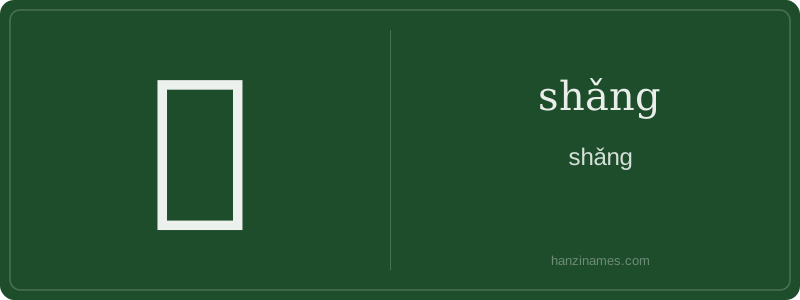
垧 remains actively used in official land surveys and rural property records across Northeast China. The Heilongjiang Provincial Department of Natural Resources’ 2022 land use reports cite 垧 alongside mu and hectares. It appears in phrases like ‘承包垧数’ (contracted land area in 垧) and is required in village-level farmland transfer agreements. No common idioms contain 垧; its usage is strictly technical and geographic—not literary or metaphorical.
The character is a phono-semantic compound: 土 (tǔ, ‘earth’) as semantic radical signals meaning domain; 尚 (shàng) as phonetic component approximates pronunciation (shǎng vs. shàng). It first appeared in modern Chinese dictionaries in the 1930s, not in ancient texts—confirming its 20th-century origin as a regional administrative unit, not a classical measure.
垧 (shǎng) is a traditional Chinese unit of land area, primarily used in rural Northeast China—especially in Heilongjiang, Jilin, and Liaoning provinces. Unlike standardized metric units, 垧 reflects regional agrarian practices: one 垧 equals 15 mu (≈1 hectare or 2.47 acres). Its usage persists in land registration, agricultural contracts, and local government documents, though it’s absent from national standards like GB/T 18521–2001, which favors hectares and mu.
In Western contexts, 垧 has no direct equivalent—acres, hectares, and arpents all differ in size and legal function. An acre (0.405 ha) is smaller than a 垧 (~1 ha), while a hectare is nearly identical but globally standardized and legally binding. The 垧, by contrast, carries historical weight as a locally negotiated measure, rooted in early 20th-century Manchurian land reform and Soviet-influenced collectivization efforts.
This character exemplifies how measurement units encode cultural geography: 垧 isn’t just quantity—it signals regional identity, bureaucratic legacy, and the resilience of vernacular systems amid national standardization. For learners, recognizing 垧 opens a window into China’s spatial history—not merely ‘how much land,’ but ‘whose land, measured how, and why here.’ Its radical 土 (earth) visually anchors it in soil, cultivation, and territorial belonging.
Example Sentences
Common Compounds
Similar Characters — Don't Mix These Up
Your First Step into Chinese Culture: Get a Chinese Name
Every journey into Chinese begins with a name. Use our free Chinese name generator to create a meaningful, personalized Chinese name that fits you perfectly.
Get My Chinese Name →