埇
Character Story & Explanation
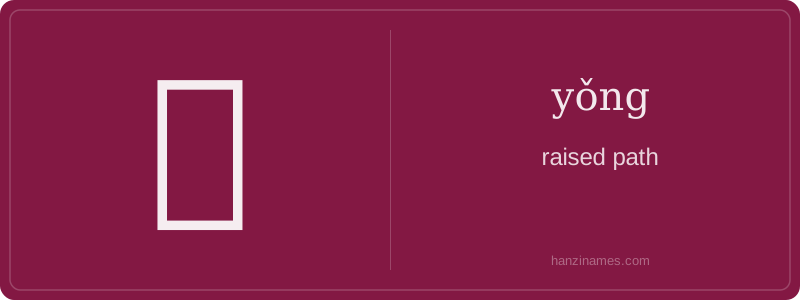
埇 is primarily used today in the name of Yǒngqī County (埇桥区, Yǒngqiáo Qū), a district in Suzhou City, Anhui Province—a well-documented administrative division established in 1998. It appears on official signage, postal addresses, and local government websites. You’ll never hear it in casual speech, nor will it appear in idioms or literature; it exists almost solely as a toponymic element, preserved for historical continuity and geographic specificity.
The character’s form reflects its meaning: the left-side 土 (earth/turf) signals terrain-related semantics, while the right-side 永 (yǒng) provides phonetic guidance—though its original oracle-bone or bronze script origin is not attested for 埇. Historically, ‘raised paths’ referred to elevated earthen roads built along riverbanks or wetlands in northern and central China, a practical solution documented in Song- and Ming-dynasty local gazetteers.
Hello, learners! Today we’ll explore 埇 (yǒng), a character you won’t find in everyday conversation—but one that’s deeply rooted in China’s geographical and administrative landscape. It’s a 10-stroke character with the ‘earth’ radical (土), telling us it relates to land or terrain. Though rare in modern spoken Chinese, it appears reliably in proper nouns—especially place names—so recognizing it helps you read maps, signs, and official documents accurately.
Don’t be misled by its simple appearance: 埇 isn’t used as a standalone verb or adjective like ‘walk’ or ‘high’. Instead, it functions almost exclusively as part of compound nouns tied to real locations. Its meaning—‘raised path’ or ‘elevated roadbed’—comes from ancient civil engineering: raised earthen paths built to stay above floodwaters or marshy ground. Think of it like an early form of a causeway or embankment.
As a beginner, your goal isn’t to memorize abstract definitions but to spot patterns. Notice how 土 (earth) combines with 永 (yǒng, ‘eternal’, here acting phonetically)—a common strategy in Chinese characters. This phonosemantic structure helps you decode pronunciation and meaning at once. While 埇 isn’t in the HSK lists (it’s outside HSK 1–6), understanding it builds literacy for reading real-world Chinese, especially regional geography and government materials.
Example Sentences
Common Compounds
Similar Characters — Don't Mix These Up
Your First Step into Chinese Culture: Get a Chinese Name
Every journey into Chinese begins with a name. Use our free Chinese name generator to create a meaningful, personalized Chinese name that fits you perfectly.
Get My Chinese Name →