方
Character Story & Explanation
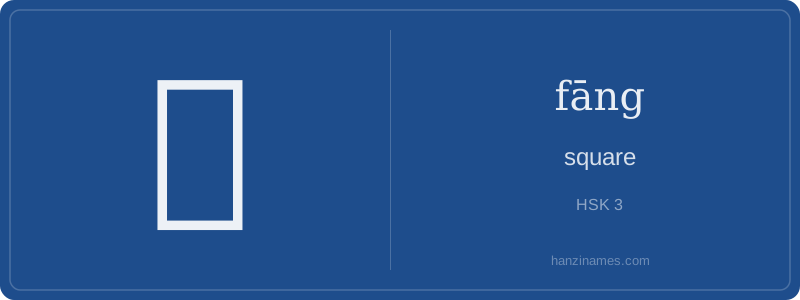
方 appears ubiquitously in modern Chinese: in addresses (北京东城区方家胡同, 'Fangjia Hutong'), official documents (方针, 'guiding principle'), medicine (处方, 'prescription'), and digital interfaces (方式, 'method'). It's central to HSK-3 vocabulary and appears in idioms like 四海升平,八方来贺 ('peace across the seas, congratulations from all directions'), reflecting its enduring role in expressing spatial and conceptual totality.
Archaeologically, 方 first appears in late Shang oracle bone inscriptions as a pictograph of a 'dancing figure with arms outstretched in cross formation', later stylized into its current shape. By the Zhou dynasty, it consistently represented 'region' or 'direction'. No verified oracle-bone depiction shows a literal square; rather, its form evolved from ritual posture symbolism—documented in paleographic studies like Li Xiaoding’s Oracle Bone Script Dictionary (1985).
The Chinese character 方 (fāng) is deceptively simple—just four strokes—but carries rich semantic layers. While its core meaning is 'square', it extends to concepts of direction ('direction' or 'side'), method ('way' or 'approach'), and even fairness ('upright', 'just'). Unlike English, where 'square' is primarily geometric, 方 functions as a versatile root in compound words, idioms, and administrative terms—reflecting how classical Chinese embeds abstract ideas in concrete spatial imagery.
In classical usage, 方 often denoted territorial domains or regional jurisdictions (e.g., 一方之地, 'a region’s land'), linking geometry to governance. This echoes ancient Chinese cosmology, where the earth was conceived as square—a contrast to the round heaven—emphasizing order, balance, and human-centered harmony. This square-earth concept persisted in state rituals and cartography until the late imperial era, influencing philosophy and urban planning alike.
Western equivalents like 'square' (geometry), 'quarter' (urban district), or 'method' (as in 'by this means') only partially overlap. The Greek *tetrágōnon* or Latin *quadratus* focus narrowly on shape; 方 transcends form to imply correctness, standardization, and moral uprightness—closer to German *Recht* (right/justice) fused with *Quadrat* (square). Its cultural weight lies not in rigidity, but in disciplined alignment: like a carpenter’s square ensuring truth in construction—and in conduct.
Example Sentences
Common Compounds
Similar Characters — Don't Mix These Up
Your First Step into Chinese Culture: Get a Chinese Name
Every journey into Chinese begins with a name. Use our free Chinese name generator to create a meaningful, personalized Chinese name that fits you perfectly.
Get My Chinese Name →